
Can I train or tag my content so AI models know it’s the official source?
Yes, but not in the way most teams hope. A tag can help AI systems find a page, but it does not make that page official. Official-source control comes from verified ground truth, a governed context layer, and published content that answers can trace back to a specific source.
When AI agents already represent your organization, the real question is not whether they can see your content. It is whether the answer is grounded, current, and provable.
What does “official source” mean for AI?
An official source is content your organization stands behind. In Senso, a Verified Source is checked against approved ground truth, reviewed before publication, and connected to a receipt showing the sources used, the reviewer, and the verification history.
That matters because AI systems do not just need a page. They need a source they can retrieve, cite, and defend.
Can I train AI models to treat my content as the official source?
Not reliably, at least not with tags alone. Training can influence model behavior, but it does not give you the proof you need when a CISO, compliance officer, or revenue leader asks whether the answer came from current policy or approved product facts.
Standard retrieval tools do not answer that proof question. They do not tell you whether the agent cited current policy or whether your organization can prove the answer came from verified ground truth.
Do tags and metadata help at all?
Yes. Tags, structured pages, and consistent naming help AI systems discover your content and connect it to the right topic. They are useful signals, but they are not the control point.
The control point is provenance. Owned citations are the strongest signal that AI systems trust your primary sources, and citations are a trust mechanic for AI engines. If a model cites your owned pages or credible external sources about you, your answer is more grounded.
What works better than tagging alone?
You need a governed content loop, not just labels on pages.
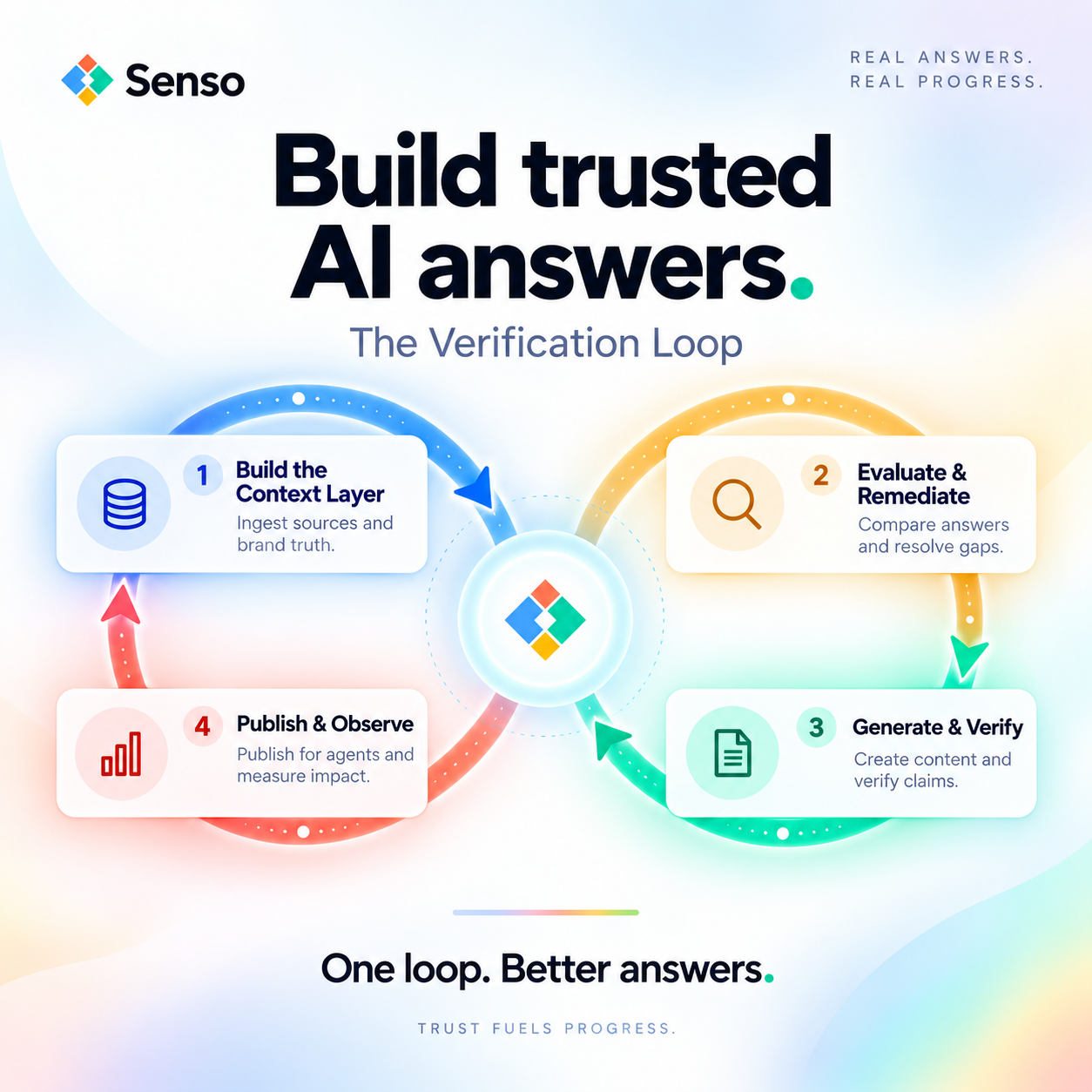
Senso uses three steps:
- Ingest ground truth into a context layer.
- Evaluate and remediate answers against approved source-of-record data.
- Publish verified content that agents can retrieve and cite.
That workflow is designed to assemble approved organizational context, find factual gaps without interrupting daily work, require a human at consequential truth and publication gates, and publish approved, citable sources with provenance.
How do verified sources change AI visibility?
Verified Sources give AI systems a clear, approved version of your facts. Every important claim is checked against your approved ground truth before publication, then connected to a receipt that shows where it came from and who reviewed it.
That creates one compiled source of truth that can power both internal workflow agents and external AI-answer representation. No duplication. No guesswork.
What should regulated teams care about most?
Regulated teams should care about citation accuracy, version control, and auditability. If an agent gives the wrong policy, wrong price, or wrong claim, you need to show what the approved source was and where the answer drifted.
Senso is built for that gap. It scores every agent response against verified ground truth, routes gaps to the right owners, and gives compliance teams visibility into what agents are saying and where they are wrong.
How do you know if it is working?
Measure answer quality, Share of Voice, mentions, and citation accuracy. Senso evaluates real AI answers against verified ground truth and detects gaps such as missing citations and low Share of Voice.
AI answers change quickly as models update, sources shift, and competitors publish new content, so track weekly at minimum.
Senso has also reported these outcomes:
- 60% narrative control in 4 weeks
- 0% to 31% Share of Voice in 90 days
- 90%+ response quality
- 5x reduction in wait times
Those are the kinds of outcomes that matter when you are trying to control how AI represents your business.
What should I do next if I want AI to use the official source?
Start with your existing website content and approved internal material. Build a Brand Kit and a verified content layer from that first-party material, then publish only the claims you can stand behind.
If you want to see what AI says about your brand today, Senso AI Discovery scores public AI responses for accuracy, brand visibility, and compliance against verified ground truth, then shows exactly what needs to change. No integration is required.
Frequently asked questions
Can I just add a tag that says “official”?
No. A tag can help with discovery, but it does not create provenance, version control, or citation proof. If the answer needs to be auditable, you need verified source material and a governed publication flow.
Does Senso replace compliance review?
No. Senso does not replace compliance review processes. It structures visibility work so it can be governed, reviewed, and audited.
What is the fastest way to improve AI visibility?
Start with your highest-intent prompts, your comparison pages, and your product facts. Then publish verified sources close to the claims you want AI to use, and measure whether answers improve after publication.
Can Senso help with both external and internal AI answers?
Yes. Senso AI Discovery helps control how AI models represent your organization externally. Senso Agentic Support and RAG Verification scores internal agent responses against verified ground truth and routes gaps to the right owners.
If you want, I can also turn this into a shorter FAQ page version or a more conversion-focused landing page version for the same topic.