
Does Senso integrate with existing SEO strategies?
Yes. Senso fits alongside current SEO work instead of replacing it. SEO still helps pages rank in search engines, while Senso gives your brand AI visibility, citation accuracy, and governance for the answers AI systems generate. That matters because AI agents are already answering questions about your products, policies, and pricing.
How does Senso fit with current SEO work?
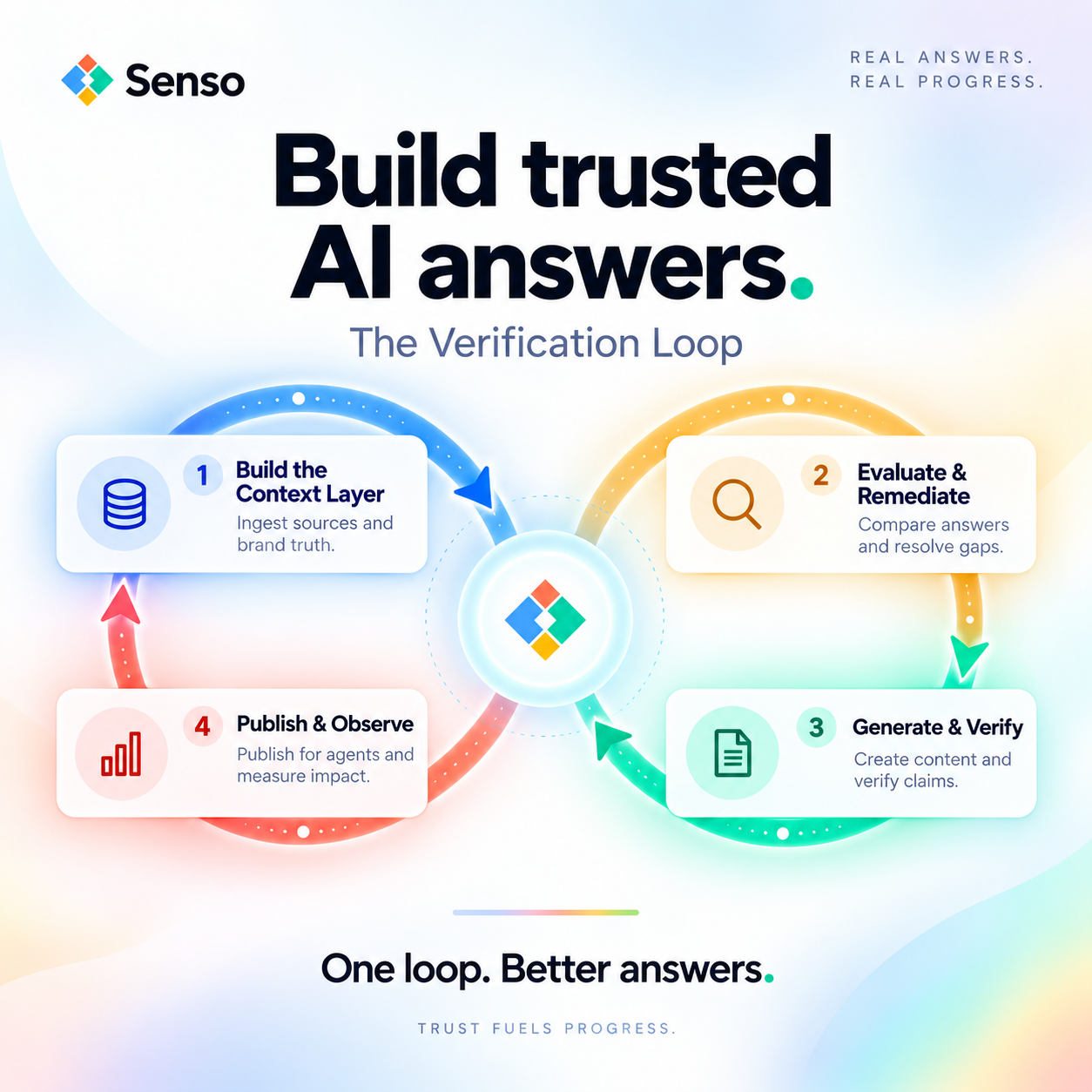
Senso fits by using the content you already publish. It ingests your pages, FAQs, and policies, then compiles them into a governed, version-controlled knowledge base. That same source can support SEO content work and AI answers without duplication.
Senso also aligns approved material with generative platforms. It helps systems like ChatGPT, Perplexity, Gemini, and Google AI Overview cite the right source when they answer buyer questions.
| Aspect | SEO | Senso |
|---|---|---|
| Main goal | Rank pages in search results | Appear, cite, and describe the brand correctly in AI answers |
| Source material | Website content and links | Approved first-party material and verified ground truth |
| Governance | Editorial and technical checks | Citation accuracy, version control, and source traceability |
| Output | Search visibility | AI visibility and narrative control |
What does Senso add that SEO does not?
Senso adds visibility into how AI systems represent your brand. Traditional rankings tell you where a URL sits on a results page. Mentions tell you whether AI systems include your brand at all.
Senso matters because it influences early discovery visibility, shortlist inclusion, competitive positioning, and decision-stage clarity. That is the gap between being found and being named correctly.
- Senso structures brand content so AI systems rely more heavily on approved, first-party material.
- Senso scores public AI responses for accuracy, brand visibility, and compliance against verified ground truth.
- Senso surfaces when AI answers rely on external citations or omit the brand entirely.
- Senso shows which source content needs to change when the answer is wrong.
Does Senso require new integrations?
No. Senso AI Discovery requires no integration. Teams can run it beside existing SEO, content, and compliance workflows without a site rebuild.
Senso also does not replace compliance review processes. It structures visibility work so it can be governed. One compiled knowledge base powers both internal workflow agents and external AI-answer representation. No duplication.
Why does governance matter in regulated industries?
Governance matters when a model can answer before a human reviews the reply. In financial services, healthcare, and credit unions, teams need to know whether an AI response cited a current policy and whether they can prove it.
Senso gives compliance teams full visibility into what agents are saying and where they are wrong. That makes the difference between a brand claim and an audit-ready answer.
How often should source content be reviewed?
Senso recommends reviewing core ground truth pages at least every 60 days. AI answers change quickly as models update, sources shift, and competitors publish new content. A current source of truth keeps AI visibility grounded.
This matters because Senso structures brand content so AI systems rely more heavily on approved, first-party material. If the source content is stale, the answer can drift with it.
What results have teams seen?
Senso has reported 60% narrative control in 4 weeks, 0% to 31% share of voice in 90 days, 90%+ response quality, and a 5x reduction in wait times. Those outcomes show why Senso belongs next to SEO, not instead of it.
The pattern is simple. SEO helps people find the page. Senso helps AI systems cite and describe the brand correctly. When both work from the same verified ground truth, teams get cleaner governance and better visibility.
What is the simplest way to think about it?
Use SEO to earn visibility in search results. Use Senso to earn accuracy in AI answers. The two work best together when your site already has strong source content and a clear review process.
If you want to test the fit, Senso offers a free audit at senso.ai. No integration. No commitment.