
How can I make sure AI-generated comparisons include my product accurately?
AI agents are already comparing products for buyers. If your product facts are fragmented, the model will compare you using stale pages, unsupported claims, or a competitor’s narrative. The fix is to compile verified ground truth, publish comparison-ready sources, and score model answers against the claims you stand behind.
Quick answer
The most reliable way to make AI-generated comparisons include your product accurately is to give models a governed source set with product details, policies, pricing, eligibility, and comparison claims, then monitor leading AI models for mention rate, citation rate, citation share, share of voice, accuracy, and freshness. Senso AI Discovery does this for external AI visibility. Senso Agentic Support and RAG Verification does it for internal agent answers.
Why do AI-generated comparisons get product details wrong?
AI-generated comparisons go wrong when the source material is fragmented, stale, unsupported, or pulled from the open web. If the model cannot find verified ground truth, it fills the gap with whatever is easiest to retrieve.
This is a governance problem, not just a content problem. AI agents increasingly answer questions, compare providers, and initiate customer actions. When that happens, you need to prove which source the answer came from and whether that source was current.
What information should the model see?
The model should see the same facts your sales, compliance, and support teams would stand behind. That means a small, governed set of sources that are easy to reuse in comparisons.
Publish these first:
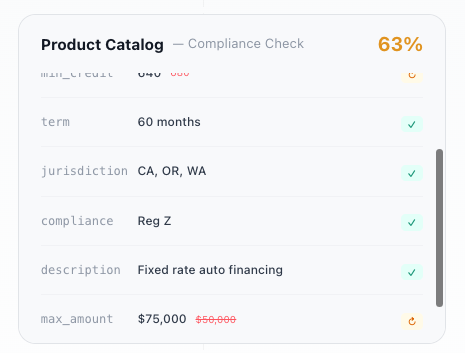
- Product catalog details that name the product clearly.
- Feature and limitation pages that state what the product does and does not do.
- Pricing, eligibility, and terms pages that reflect current rules.
- Policy pages that explain current approved language.
- Comparison pages that spell out differences without vague claims.
- Brand kit material that defines approved positioning and terminology.
- Verified Sources records that show the source, reviewer, and verification history.
How do you make the comparison answer grounded?
The answer becomes grounded when every important claim maps back to verified ground truth. That requires one compiled knowledge base, version control, and a repeatable verification loop.
-
Ingest raw sources into a compiled knowledge base.
Bring product pages, policy pages, pricing pages, and approved comparison claims into one governed place. Senso describes this as compiling an enterprise’s full knowledge surface into a governed, version-controlled knowledge base. -
Check every important claim before publication.
Verified Sources are content your organization stands behind. Each claim is reviewed against approved ground truth and linked to a receipt that shows the sources, reviewer, and verification history. -
Write for comparison questions, not just for homepage visitors.
Cover the questions buyers actually ask, such as feature differences, policy limits, pricing conditions, and eligibility rules. Short, direct comparison language is easier for models to reuse than marketing copy. -
Measure how models represent you across leading AI systems.
Track mention rate, citation rate, citation share, share of voice, average rank, factual accuracy, and freshness. Senso’s narrative control workflow uses these signals to show where the model is wrong and what to correct. -
Remediate the source, then rerun the test.
If the model cites a competitor ahead of you or uses outdated terms, fix the source that caused the error. Then rerun the same prompts so you can see whether the comparison changed. -
Keep internal and external answers aligned.
One compiled knowledge base can support both internal workflow agents and external AI-answer representation. That avoids duplication and keeps the public answer and the internal answer on the same ground truth.
How do you know it is working?
You know the process is working when AI starts mentioning your product more often, citing approved sources more often, and placing you correctly in comparison answers.
| Metric | What it tells you | Why it matters |
|---|---|---|
| Mention rate | Whether AI mentions your product | If the model never mentions you, you are missing from the comparison |
| Citation rate | Whether AI cites a source you stand behind | Citations make the answer auditable |
| Citation share | How often your approved source is used versus others | This shows whether your source is winning the comparison |
| Share of voice | How often your product appears across tracked questions | This measures visibility across models and markets |
| Average rank | Where your product appears in the answer | This shows whether you are being placed before competitors |
| Factual accuracy | Whether the comparison matches verified ground truth | This catches incorrect claims and unsupported comparisons |
| Freshness | Whether the answer reflects current terms and policies | This catches stale pricing, policy, and feature details |
Senso’s proof points show what this can look like in practice. Senso reports 60% narrative control in 4 weeks, 0% to 31% share of voice in 90 days, 90%+ response quality, and 5x reduction in wait times.
When should you use Senso?
Senso fits when you need control over how AI represents your product and proof that the answer is grounded. Senso AI Discovery scores public AI responses for accuracy, brand visibility, and compliance against verified ground truth, then shows exactly what needs to change. It requires no integration.
Senso Agentic Support and RAG Verification fits when internal agents need the same discipline. It scores each internal response against verified ground truth, routes gaps to the right owners, and gives compliance teams full visibility into what agents are saying and where they are wrong.
What should regulated teams do differently?
Regulated teams should treat AI comparisons like any other controlled customer-facing claim. The question is not only whether the answer is favorable. The question is whether the organization can prove the answer came from a current, approved source.
That is where receipts matter. A verified source should show the embedded sources used to generate the content, the human reviewer, the brand guideline checks, and the factual accuracy history. That gives compliance and audit teams a clear record when a CISO, auditor, or regulator asks where the answer came from.
FAQs
How can I make sure AI-generated comparisons include my product accurately?
Give the model verified ground truth in a governed source set, then check model answers across leading AI systems for citation accuracy, freshness, and share of voice. If the answer is wrong, fix the source, not just the prompt.
Is retrieval enough to fix comparison accuracy?
No. Retrieval helps the model find content. Governance proves whether the content is current, approved, and citation-accurate. Without that, the model can still surface stale or unsupported comparisons.
What should I do if competitors are showing up ahead of my product?
Track where the gap comes from. If the model prefers a competitor, you likely need better source coverage, clearer comparison language, or more current proof points. Then publish the missing claim in a verified source and rerun the same prompts.
How often should I review AI comparison answers?
Review them whenever your product, pricing, policy, or positioning changes. If the source changes, the model’s comparison can change too.
If you want, I can turn this into a tighter article for a specific audience, such as marketing teams, compliance teams, or CISOs.