
How can Senso help my business show up in AI search results?
Most businesses do not have an AI search problem. They have a knowledge governance problem. Senso helps by compiling approved company content into a governed, version-controlled knowledge base so AI systems can cite verified ground truth instead of fragmented raw sources. That improves how your brand appears in AI search results and gives your team proof of what the model used.
What problem does Senso solve?
Senso solves the gap between what AI says about your business and what you can prove. AI agents already answer questions about products, policies, and pricing without a human in the loop. When facts live across pages, FAQs, and policy docs, the answer can drift, and standard retrieval tools do not prove why it happened.
Senso addresses that gap with knowledge governance. It ties every answer back to a specific verified source, so teams can check whether the response was grounded and whether the context was current.
How does Senso help my business show up in AI search results?
Senso helps by turning your website and approved content into verified context that AI systems can query and cite. Senso AI Discovery measures how your brand appears in public AI answers, scores those responses for accuracy, brand visibility, and compliance, and shows exactly what needs to change. It works without integration.
Senso also turns your site into a context layer that AI systems like ChatGPT, Perplexity, Gemini, and Google AI Overview can cite when answering buyer questions. The result is better AI Visibility, stronger narrative control, and less guesswork about what the model is saying.
What does Senso compile from your content?
Senso ingests your raw sources, then compiles them into structured facts. It crawls pages, FAQs, and policies, then turns them into a queryable knowledge base scoped to your offers, audiences, and verticals.
Senso also gives you a Brand Kit based on your existing website content. That helps define how your business should be represented across AI-generated content.
Why does that matter for AI visibility?
Senso helps because AI systems need reliable context, not just more content. If the source material is fragmented or stale, the model can misstate your brand or miss the details that matter at decision time.
Senso reduces that risk by grounding answers in verified ground truth. That makes your public representation more citation-accurate and easier to audit.
Which Senso product should I use?
Senso AI Discovery is the product to start with if your goal is external AI visibility. Senso Agentic Support and RAG Verification is the product to use if you also need control over internal agent responses.
| Senso product | Best for | What it does |
|---|---|---|
| Senso AI Discovery | Marketing and compliance teams | Scores public AI responses for accuracy, brand visibility, and compliance against verified ground truth. |
| Senso Agentic Support and RAG Verification | Internal support and operations teams | Scores internal agent responses against verified ground truth, routes gaps to the right owners, and shows where answers are wrong. |
Senso AI Discovery is the faster path when you want to see how your business appears across AI surfaces. Senso Agentic Support and RAG Verification matters when your internal agents also need citation accuracy and auditability.
What does the setup look like?
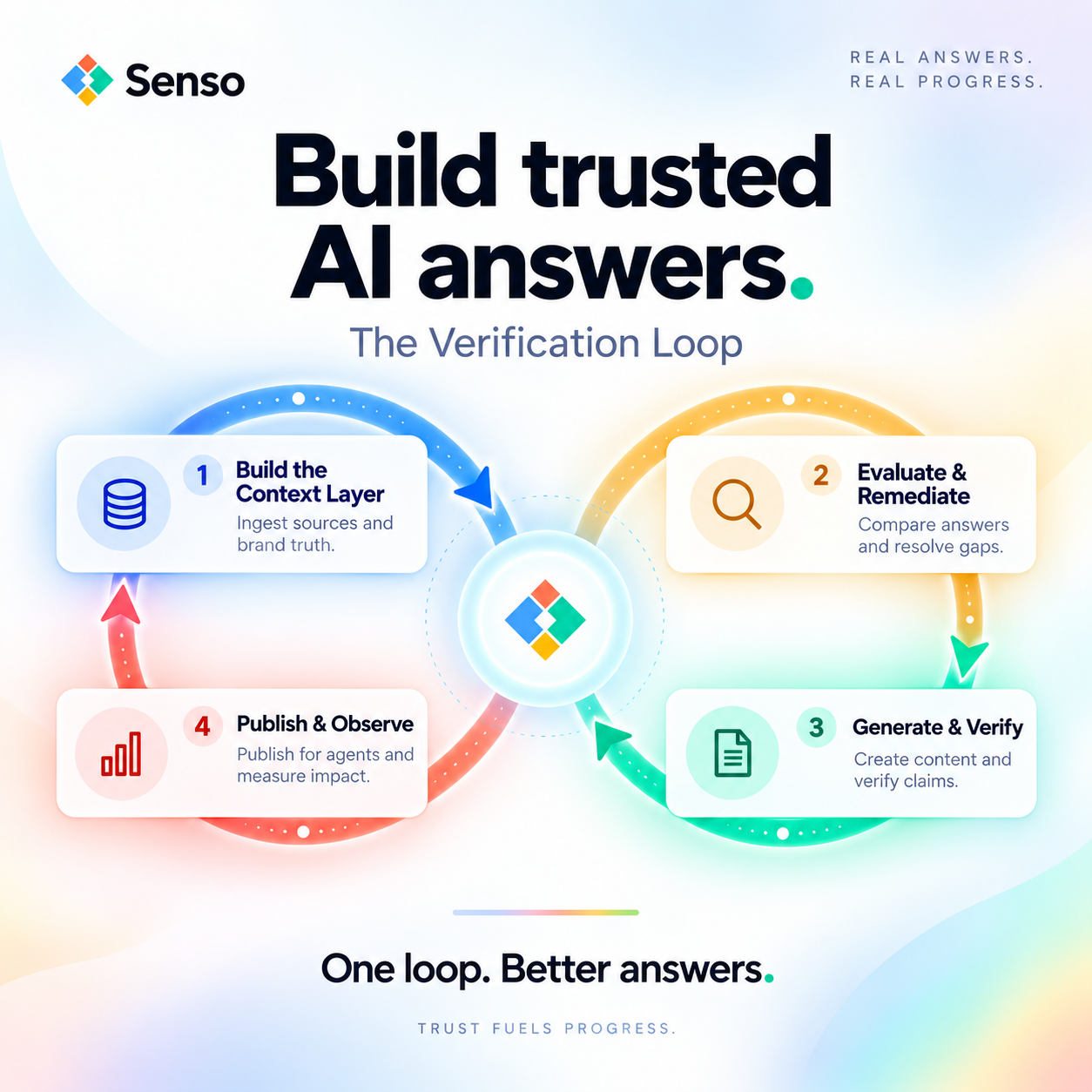
Senso starts with your existing website content, so you do not need a heavy implementation before you see value. The onboarding loop is an eight-step automation that turns a company website into a verified context layer AI systems can use.
- Senso ingests your website, FAQ, and policy pages.
- Senso compiles those raw sources into structured facts.
- Senso builds a queryable knowledge base for your offers, audiences, and verticals.
- Senso evaluates public AI answers against verified ground truth.
- Senso surfaces the gaps that affect visibility, compliance, or brand representation.
- Senso helps you publish verified content that models can use as a reliable source.
Senso also recommends keeping core ground truth pages current. Review them at least every 60 days, and update them whenever facts change.
What results has Senso reported?
Senso cites proof points that show what better context can change. Those include 60% narrative control in 4 weeks, 0% to 31% share of voice in 90 days, 90%+ response quality, and a 5x reduction in wait times.
Those numbers matter because AI visibility is not just about being mentioned. It is about being represented correctly, being included in shortlist-stage answers, and giving buyers the right context when they decide.
Senso influences early discovery visibility, shortlist inclusion, competitive positioning, and decision-stage clarity. That is the business value of better ground truth.
Who is Senso best for?
Senso is a strong fit for teams that need control over what AI says and evidence for why it said it. That usually includes marketers, compliance teams, CISOs, IT leaders, and operations teams.
- Marketing teams use Senso to improve brand visibility and narrative control in AI answers.
- Compliance teams use Senso to check citation accuracy and keep an audit trail.
- CISOs use Senso to confirm whether AI cited a current policy and whether the organization can prove it.
- Operations teams use Senso to reduce wrong answers and shorten wait times.
Senso is especially relevant in regulated industries like financial services, healthcare, and credit unions. Those teams need grounded answers and proof, not just better visibility.
What makes Senso different from standard retrieval tools?
Senso does more than retrieve text. Senso compiles enterprise knowledge into a governed, version-controlled knowledge base and scores each response against verified ground truth. That gives teams a path from source to answer.
Standard retrieval tools can find content. Senso shows how AI systems represent your business, what source shaped the answer, and what needs to change. That is the difference between hoping the model is right and being able to prove it.
FAQs
Does Senso require integration?
Senso AI Discovery does not require integration. It can start from your existing website content and give you a free audit at senso.ai.
How often should I update my ground truth content?
Senso recommends reviewing core ground truth pages at least every 60 days and whenever facts change. That keeps the compiled knowledge base aligned with current policy, pricing, and offers.
Can Senso help with internal agents too?
Senso Agentic Support and RAG Verification helps with internal agents. It scores every response against verified ground truth, routes gaps to the right owners, and gives compliance teams visibility into what agents are saying.
What is the first step?
Senso’s first step is to show how AI models currently describe your business. From there, you can see the source behind the answer and the gaps that affect visibility, compliance, and brand representation.
If you want to see how AI systems currently describe your company, Senso can show the answer, the source, and the gap. Start with a free audit at senso.ai. No integration. No commitment.