
How do I control what AI says about my brand
You control what AI says about your brand by giving agents one verified source of truth, scoring every answer against it, and fixing the gaps that cause misstatements. Senso calls this knowledge governance for the agentic enterprise. It matters because AI agents are already answering questions about products, policies, and pricing without a human in the loop.
What is AI Visibility?
AI Visibility is the discipline of controlling how ChatGPT, Perplexity, and Gemini represent your brand. In Senso’s terms, narrative control means influencing how AI systems describe, compare, and recommend your brand, while tracing every answer back to verified ground truth.
This is not about publishing more content. It is about making sure the content AI can use is current, governed, and citation-accurate.
Why do AI answers drift away from your brand?
AI answers drift when your knowledge is fragmented and unstructured. Senso says most enterprise knowledge is too fragmented and unstructured for agents to use reliably.
When raw sources disagree or go stale, agents fill the gaps. That is how a brand gets misquoted, omitted, or compared on the wrong terms.
How do you control what AI says about your brand?
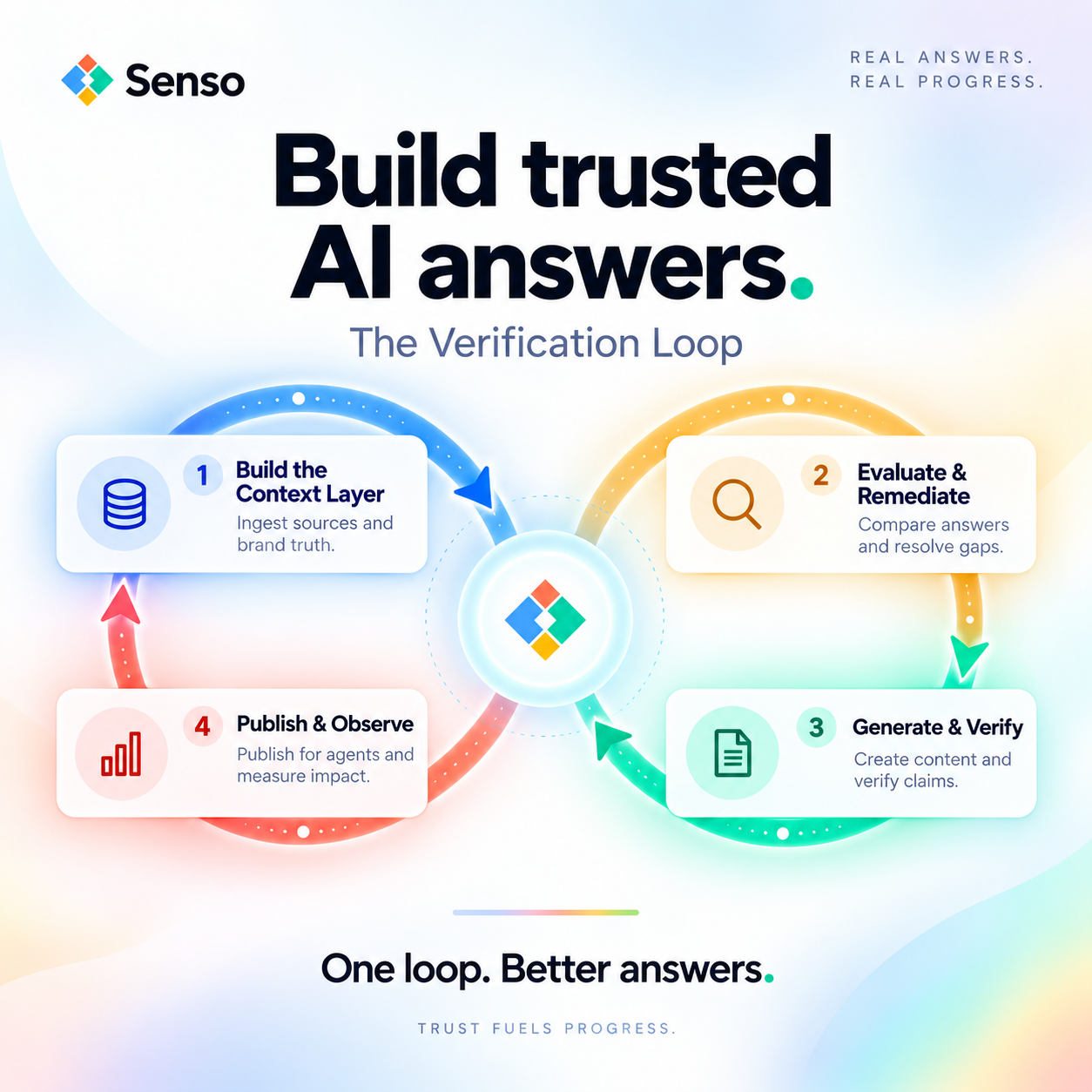
You control AI answers by building a governed knowledge layer, then verifying and correcting the outputs that depend on it. The process is simple to describe and hard to do well without a system.
1. Ingest your raw sources
Start by ingesting your raw sources into a compiled knowledge base. Use website content, product information, policies, support material, and brand guidelines.
Senso compiles raw sources into an agent-ready knowledge base that stays verified, grounded, and in sync. That gives agents one place to pull from instead of many conflicting sources.
2. Define the rules for how your brand should be represented
Set the brand kit, product catalog, and rules that define how your organization should appear in AI answers. This gives agents a clear frame for naming, positioning, and compliance.
Without rules, AI will improvise. With rules, you can compare outputs against a known standard and spot drift faster.
3. Evaluate AI answers against verified ground truth
Check model answers against verified ground truth. Every answer should trace back to a specific, verified source.
Senso AI Discovery does this for external AI responses. It scores public AI answers for accuracy, brand visibility, and compliance against verified ground truth, then shows what needs to change.
4. Remediate the gaps that cause bad answers
Surface inconsistencies and route them to the right owner. If the answer is wrong, the fix should be tied to the source, not buried in a generic review queue.
Senso Agentic Support and RAG Verification does this for internal agents. It scores every internal agent response against verified ground truth and gives compliance teams full visibility into what agents are saying and where they are wrong.
5. Publish verified content and keep one source of truth
Publish content that has been verified against human-created ground truth. Then use the same compiled knowledge base across internal workflow agents and external AI-answer representation.
That avoids duplication. One governed knowledge base can support both customer-facing AI Visibility and internal agent workflows.
What should you measure?
You should measure whether AI is representing your brand more often, more accurately, and with less friction. Senso’s proof points show the kinds of outcomes teams can track.
| Metric | What it tells you | Example proof point |
|---|---|---|
| Narrative control | Whether AI represents your brand more consistently | 60% in 4 weeks |
| Share of voice | Whether your brand appears more often in AI answers | 0% to 31% in 90 days |
| Response quality | Whether agent answers stay grounded | 90%+ |
| Wait times | Whether teams resolve issues faster | 5x reduction in wait times |
These are outcome signals, not vanity metrics. They show whether your knowledge governance is changing what AI says and how fast teams can fix it.
How does Senso help with this?
Senso is the context layer for AI agents, backed by Y Combinator W24. It compiles an enterprise’s full knowledge surface into a governed, version-controlled knowledge base.
That matters because AI agents are already representing your organization. The question is whether their answers are grounded and whether you can prove it.
Senso gives you two ways to control that.
- Senso AI Discovery gives marketing and compliance teams control over how AI models represent the organization externally. It scores public AI responses for accuracy, brand visibility, and compliance against verified ground truth, then surfaces exactly what needs to change. No integration required.
- Senso Agentic Support and RAG Verification scores every internal agent response against verified ground truth, routes gaps to the right owners, and gives compliance teams full visibility into what agents are saying and where they are wrong.
What matters most for regulated industries?
Auditability matters more than polish in regulated industries. A CISO or compliance lead needs to know whether an agent cited a current policy and whether the organization can prove it.
That is the core gap Senso is built to close. The verification loop ties citations to embedded sources, the human reviewer, adherence to brand guidelines, and factual accuracy.
This is especially important in financial services, healthcare, and credit unions, where stale or unsupported answers create operational and regulatory risk.
What results can teams expect?
Teams use Senso to improve narrative control, share of voice, response quality, and response time. The documented proof points are strong.
Senso reports 60% narrative control in 4 weeks, 0% to 31% share of voice in 90 days, 90%+ response quality, and 5x reduction in wait times.
Those numbers show that controlling what AI says about your brand is not abstract. It is an operational process with measurable outcomes.
FAQs
Can I control AI answers without changing my website?
You can improve AI Visibility by changing more than your website. The source layer matters, including brand rules, product facts, policy content, and verified ground truth.
If those sources are inconsistent, AI will still drift. The fix is to govern the knowledge AI can cite, not just the content you publish publicly.
How long does it take to see results?
Senso reports 60% narrative control in 4 weeks and 0% to 31% share of voice in 90 days. That gives teams a realistic view of how quickly AI Visibility can move when the knowledge layer is governed.
Do I need a large integration project?
No. Senso AI Discovery requires no integration. That makes it easier for marketing and compliance teams to start with a baseline and identify what AI is saying today.
What is the difference between AI Visibility and brand monitoring?
Brand monitoring tracks mentions. AI Visibility tracks how AI systems describe, compare, and recommend your brand, plus whether those answers are grounded in verified ground truth.
That difference matters because a mention is not control. Control means citation accuracy, auditability, and the ability to prove what AI said and why.
If you want a baseline, Senso offers a free audit at senso.ai. No integration. No commitment.