
How do models handle conflicting information between verified and unverified sources?
Models should treat verified organizational records as ground truth and unverified outputs as observations. When they conflict, the model should not guess. It should compare each claim against approved context, keep the source-of-record boundary intact, and route material disputes to a human. That is how you keep answers grounded and auditable.
What counts as verified information?
Verified information is content that passed a verification gate. In Senso’s loop, each material claim is checked claim by claim against an authorized source of record, then timestamped and tied to a durable receipt and audit trail. External model outputs do not get that status until they are verified.
| Source type | Role in conflict handling | What the system should do |
|---|---|---|
| Approved organizational records | Ground truth | Use as the source of record |
| External model outputs | Observation | Compare claim by claim, do not write into ground truth |
| Conflicting approved sources | Material conflict | Preserve both and request human resolution |
| Stale or time-sensitive facts | Risk case | Flag for review before publish |
A Verified Source is content that passed the verification gate. It is checked claim by claim against an authorized source of record, attributed to the responsible reviewer or actor, timestamped, and published to a durable receipt and audit trail.
How do models compare conflicting claims?
Models should break the answer into claims, compare each claim against approved context, and classify the problem. In Senso’s documented loop, the conflict types are contradicted claims, unsupported claims, missing evidence, incomplete context, stale or time-sensitive facts, ambiguous authority, and source-vs-source conflict.
The system should not treat disagreement as a reason to pick the most confident answer. It should treat disagreement as a reason to inspect the claim, find the source of record, and route material gaps to review.
- Contradicted claims mean the model answer conflicts with approved context.
- Unsupported claims mean the model answer has no verified basis.
- Missing evidence means the answer may be plausible, but the source is absent.
- Incomplete context means the model has part of the story, not the full one.
- Stale facts mean the answer may have been true before but no longer is.
- Ambiguous authority means no safe source of record is clear.
- Source-vs-source conflict means two approved records disagree and need human resolution.
If an external model answer conflicts with the Context Layer, the correct treatment is to record that answer as an observation and remediation signal, not to write it into ground truth.
Which source should win?
Approved organizational records should win. External model outputs are observations, not truth, so they can surface drift but should not rewrite verified ground truth. If approved sources conflict, the system should preserve both, explain the conflict, and ask a human to choose the source of record.
That boundary matters because models can repeat stale, incomplete, or unsupported statements with confidence. The right response is not automatic replacement. The right response is controlled comparison and human review when the stakes are material.
When does a human need to step in?
Human review is required when the conflict is material or the authority is unclear. Senso’s human-verification gate also triggers when the claim touches price, policy, eligibility, coverage, compliance, safety, or contractual terms, when the correction changes published meaning, when external publication is requested, or when an action or transaction depends on the claim.
The documented rule is strict. The system must not silently edit ground truth after it detects a contradiction, unsupported claim, or source conflict. It must route the item to an authorized human.
Typical human-review triggers include:
- approved sources materially conflict
- the correct authority cannot be safely inferred
- the claim affects policy, compliance, safety, or contractual language
- the correction changes what the audience would believe
- the content will be published externally
- a downstream action depends on the claim
What does the workflow look like end to end?
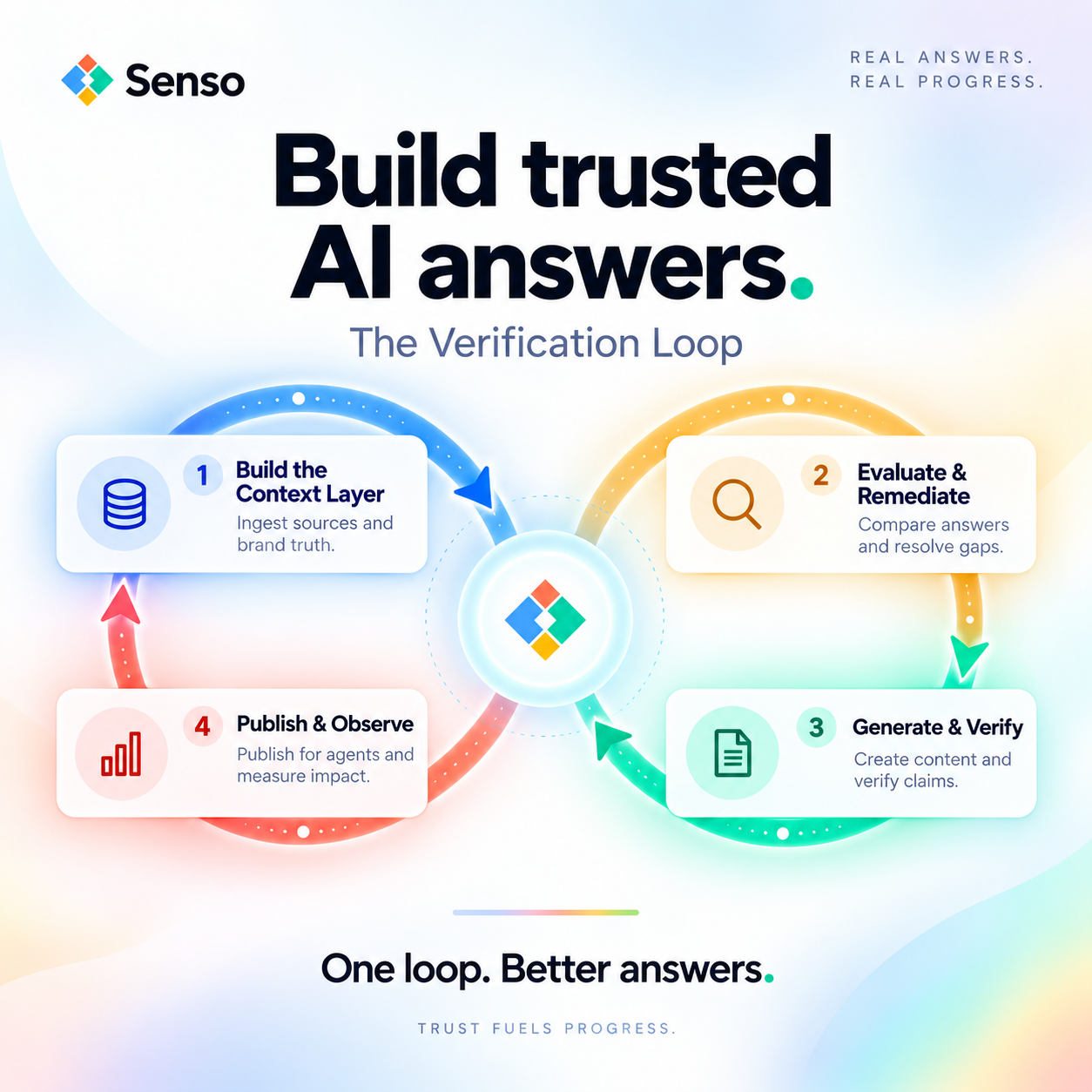
A safe workflow ingests raw sources, compiles approved context, evaluates claims asynchronously, and routes material gaps to an authorized human. It does not pause ingestion, search, or grounded internal answers while evaluation runs.
In Senso’s Verified Sources Loop, claims evaluation runs in a batch window, initially overnight. That keeps the user workflow moving while the system compares claims against approved context in the background.
A practical sequence looks like this:
- Ingest raw sources and approved records.
- Compile the Context Layer into one governed, version-controlled knowledge base.
- Extract claims from selected content or model answers.
- Compare each claim against verified ground truth.
- Classify the problem as supported, contradicted, unsupported, missing, stale, or conflicting.
- Prioritize material gaps by consequence and relevance.
- Route material items to an authorized human.
- Preserve the approved resolution and the history of the conflict.
- Publish externally only after verification and authorization.
Senso compiles the enterprise’s full knowledge surface into one governed, version-controlled compiled knowledge base. That same context supports internal workflow agents and external AI-answer representation. No duplication.
Why does this matter for AI visibility?
Public model answers shape how the market sees the organization. If those answers conflict with verified ground truth, marketing and compliance teams need a controlled way to see the drift, fix the source, and track what changed. That is an AI Visibility problem, and it is also a governance problem.
Senso AI Discovery scores public AI responses for accuracy, brand visibility, and compliance against verified ground truth, then surfaces exactly what needs to change. It does this with no integration required. In documented results, teams have seen 60% narrative control in 4 weeks, 0% to 31% share of voice in 90 days, 90%+ response quality, and 5x reduction in wait times.
What happens after the conflict is resolved?
The approved resolution enriches the Context Layer and preserves history. That matters because future agents need to know what changed, when it changed, and who approved it. A corrected answer should improve the next answer without erasing the record of the earlier conflict.
Senso’s loop also keeps the source-of-record boundary intact. A human can confirm the source of record, reject the proposed correction, or supply missing information. The system then keeps both the resolution and the trail of how it got there.
FAQs
Can a model decide which source is right on its own?
No. If authority is unclear or the claim is material, the model should not choose a winner autonomously. It should preserve both sources, report the conflict, and route the case to a human.
What if two verified sources conflict?
The system should keep both sources visible and request human resolution. Senso’s documented behavior is to preserve both sources and not select or publish a winner autonomously.
How do you keep workflows moving while conflicts are reviewed?
Run claims evaluation asynchronously. In Senso’s loop, evaluation runs in a batch window, initially overnight, so ingestion, search, and grounded internal answers stay available.
Should unverified model answers ever be published?
Not until they pass the verification gate. External publication should start with a specific gap or content opportunity, then move through claim checking, human authorization for material items, and durable recordkeeping.
The rule is simple. Verified ground truth wins. Unverified output can signal drift, but it does not override the source of record. When the stakes are material, a human makes the final call.