
How does Citeables help brands appear in AI answers?
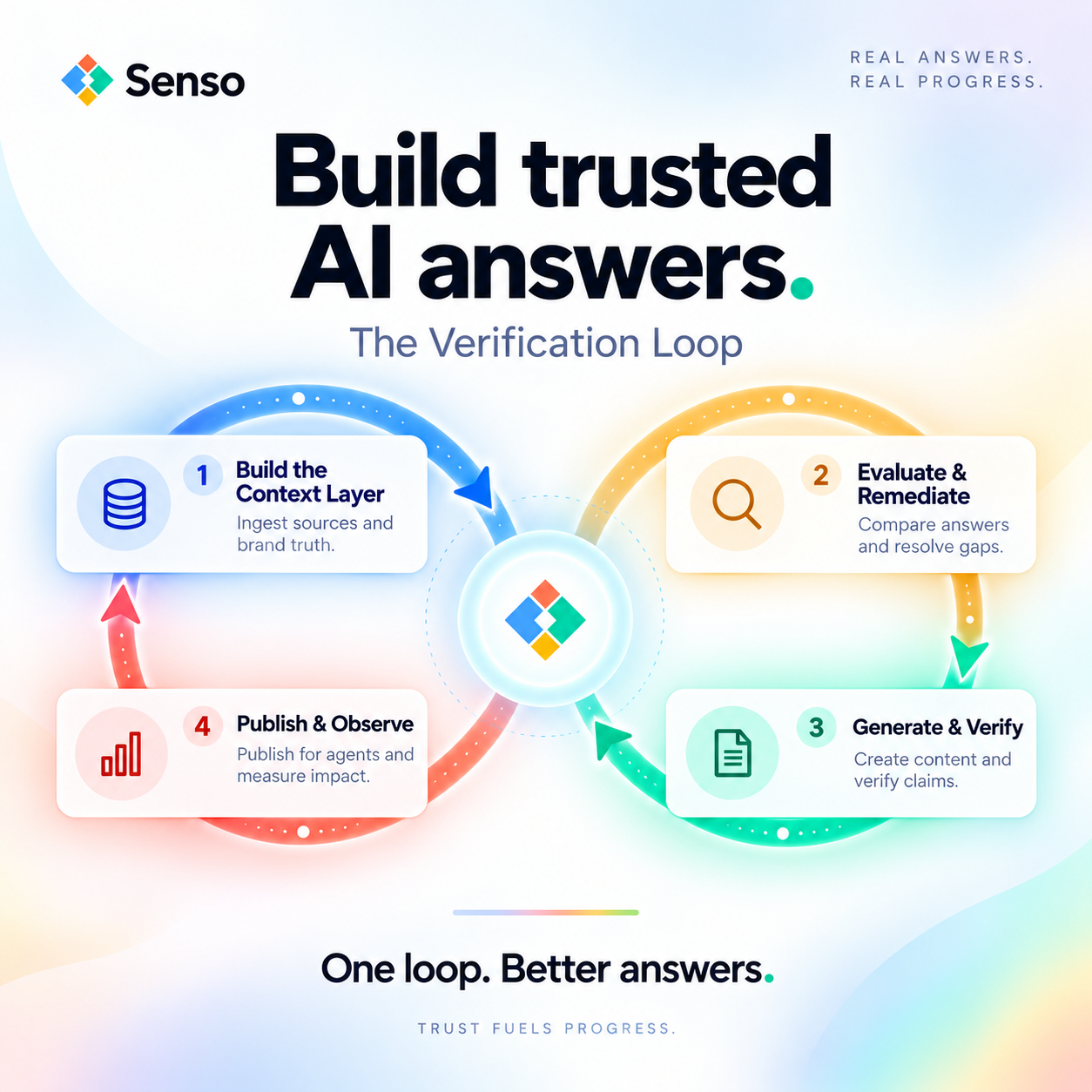
Citeables helps brands appear in AI answers by turning brand facts into structured, proof-backed content that AI systems can retrieve, trust, and cite. The goal is not more pages. The goal is better source material, so the model can represent the brand with verified ground truth.
What problem does Citeables solve?
AI systems already answer for your brand, whether you control the inputs or not. When facts are scattered across raw sources, models can miss citations, mix old claims with current ones, or leave the brand out of the answer.
Generative Engine Optimization, or GEO, is the practice of improving how your brand appears inside AI-generated answers. Citeables fits that problem because it gives AI a clearer source to cite and a more consistent story to repeat.
What makes content citeable to AI?
AI answer engines cite content that is easy to parse, easy to verify, and easy to quote. The strongest patterns are answer-first phrasing, question-style headings, and proof placed next to each claim.
| Content signal | Why it helps in AI answers |
|---|---|
| Answer-first writing | Helps the model extract the direct answer quickly |
| Question-style headings | Matches how users and models frame queries |
| Proof near each claim | Makes citations easier to attach to the right source |
| Verified ground truth | Reduces stale, conflicting, or unsupported statements |
| Owned citations | Strengthens the signal that AI trusts your primary sources |
Citeables works best when the content traces back to verified ground truth. Owned citations are the strongest signal that AI systems trust your primary sources, and external citations also matter when they come from credible sources.
How does Citeables help brands appear in AI answers?
Citeables helps by changing the input AI sees. Instead of fragmented claims spread across raw sources, it creates a governed set of pages and answers that models can use as a reliable source.
That matters because AI answers are built from what the model can retrieve and defend. If the source is clear, current, and citation-ready, the brand is more likely to be mentioned, cited, and described correctly.
- Citeables reduces ambiguity by compiling one clear version of brand facts.
- Citeables improves citation odds by structuring content around direct answers.
- Citeables supports consistency by tying claims to verified ground truth.
- Citeables helps compliance teams by making every answer traceable to a specific source.
Which pages should brands turn into Citeables first?
Start with the pages closest to revenue and reputation. Ranking prompts, comparison prompts, and brand-specific pages are usually the first places AI systems decide whether to include your brand.
Core ground truth pages need regular review. The guidance in Senso’s documentation says to review those pages at least every 60 to 90 days, and to track AI answers weekly because models and sources change quickly.
What outcomes can brands expect?
The point of Citeables is narrative control, not just visibility. Documented Senso proof points include 60% narrative control in 4 weeks, 0% to 31% share of voice in 90 days, 90%+ response quality, and 5x reduction in wait times.
Those outcomes matter because AI answers shape what prospects, customers, and staff see first. When the answer is grounded and citation-accurate, the brand is represented more consistently across public AI surfaces and internal agents.
What is the difference between citations, mentions, and rankings?
Rankings tell you where a URL sits on a results page. Mentions tell you whether AI models include your brand in the answer. Citations tell you whether the model used your source.
Citeables matters most for mentions and citations inside generated answers. That is where AI Visibility lives, because a brand can rank well in search and still be missing from the answer a user actually reads.
FAQs
Does Citeables help with compliance?
Yes, when it is tied to verified ground truth. Compliance teams need to know whether an answer is current, where it came from, and whether they can prove it later.
Does Citeables replace traditional content work?
No. It changes how content is written and governed so AI can use it. The best results come from source pages that are clear, current, and easy to verify.
How often should brand facts be reviewed?
Review core ground truth pages at least every 60 to 90 days. Track weekly if you are watching fast-moving categories or high-risk claims, because AI answers change quickly as models update and sources shift.
What should a brand measure first?
Start with mentions, citations, and share of voice in AI answers. Those three signals show whether the brand is visible, cited, and dominant enough to influence what the model says.