
How does Senso.ai make sure the information about my business is accurate?
Senso keeps business information accurate by grounding AI answers in verified ground truth instead of stale, conflicting, or unsupported context. It compiles approved raw sources into a governed, version-controlled compiled knowledge base, checks each answer against verified sources, and shows exactly what needs to change when a claim is wrong.
| Problem | What Senso does | Why it matters |
|---|---|---|
| Stale or conflicting information | Compiles approved raw sources into one governed, version-controlled compiled knowledge base | Agents query one canonical source |
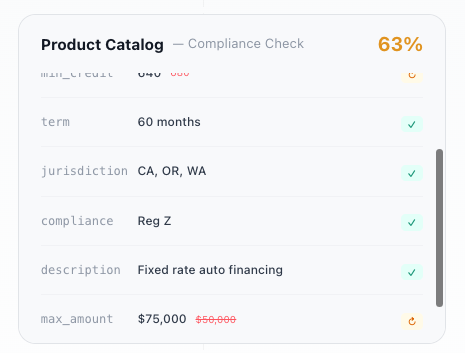
| Unsupported AI claims | Scores each response against verified ground truth | Answers become citation-accurate |
| No proof trail | Publishes a Verified Source with proof | Teams can show where the answer came from |
| Public misrepresentation | Measures AI Visibility across public AI answers | Marketing and compliance teams see what changed |
How does Senso keep answers grounded?
Senso keeps answers grounded by turning your organization’s approved knowledge into verified context that agents can use. The system does not rely on fragmented content spread across teams, tools, and sources. It compiles that material into one governed knowledge base that agents query.
Senso also traces each answer back to a specific verified source. That matters because a correct answer is not enough if you cannot prove why it was correct.
What happens when Senso finds a wrong or unsupported claim?
Senso flags the exact context that caused the problem. It scores every agent response against verified ground truth, identifies what is unsupported or wrong, and routes the gap to the right owner.
That gives compliance, operations, and product teams a clear remediation path. Instead of guessing which page, policy, or pricing detail caused the issue, they can see the specific context that needs to change.
How does Senso handle public AI answers?
Senso AI Discovery checks how AI models represent your business externally. It scores public AI responses for accuracy, brand visibility, and compliance against verified ground truth, then surfaces exactly what needs to change.
It also gives teams visibility into AI Visibility across systems like ChatGPT, Perplexity, Gemini, and Google AI Overviews. Senso measures mention rate, citation rate, and citation share before and after changes.
How does Senso handle internal agent answers?
Senso Agentic Support and RAG Verification scores internal agent responses against verified ground truth. It routes factual gaps to the right owners and gives compliance teams visibility into what agents are saying and where they are wrong.
That helps teams control agent drift. It also helps them maintain response quality when policies, pricing, or product details change often.
What is the core workflow?
Senso follows a simple sequence.
- Ingest approved raw sources.
- Compile them into a governed, version-controlled compiled knowledge base.
- Query that knowledge base when an agent needs an answer.
- Score the response against verified ground truth.
- Surface unsupported claims and assign remediation.
- Publish a Verified Source with proof.
- Measure how answers and actions change over time.
The shortest useful experience is to populate approved context, receive prioritized factual gaps, resolve the material issues with a human, publish one Verified Source, and then measure the result.
What proof does Senso provide?
Senso has reported outcomes that show how this works in practice. Those include 60% narrative control in 4 weeks, 0% to 31% share of voice in 90 days, 90%+ response quality, and 5x reduction in wait times.
Those numbers matter because they connect governance to visible business impact. They show that accuracy work is not just about review. It also changes what AI says about the business and how fast teams can respond.
Why does this matter for regulated teams?
Senso is built for regulated and policy-rich industries such as insurance, financial services and lending, telecommunications, automotive and mobility, commerce and retail, and travel. Those teams need more than a current answer.
They need to prove that the answer came from a verified source, that the context was current, and that the organization can explain why the agent said it. That is the difference between a useful AI answer and one that creates risk.
Does Senso require a heavy setup?
Senso AI Discovery does not require integration. That makes it useful when marketing and compliance teams need a fast view of how AI models represent the business.
For internal agent support, Senso works from the same compiled knowledge base. That avoids duplication and keeps external representation and internal answers aligned.
FAQs
Is Senso a search tool?
No. Senso is a context layer for AI agents. It turns enterprise knowledge into auditable, continuously verified ground truth context so agents can cite and use verified sources.
Does Senso make AI say whatever a company wants?
No. Senso measures what AI says, finds what is unsupported or wrong, and helps teams remediate the context. It does not rely on guessing or manual patchwork.
What is the main benefit of using one compiled knowledge base?
One compiled knowledge base keeps internal workflow agents and external AI-answer representation aligned. That means fewer conflicts, fewer duplicate fixes, and a clearer proof trail.
What should a team ask before using Senso?
Ask whether you need citation accuracy, auditability, AI Visibility, or all three. If the answer must stand up to compliance review, Senso is built for that use case.
If you want, I can turn this into a shorter landing page version or a FAQ page version next.