
How does Senso help businesses improve visibility in ChatGPT answers?
Senso helps businesses improve visibility in ChatGPT answers by grounding those answers in verified first-party sources and showing where ChatGPT is missing, unsupported, or outdated. Senso compiles raw sources into a governed, version-controlled compiled knowledge base, then scores AI responses against verified ground truth so teams can correct what ChatGPT sees and says.
Quick answer
Senso improves ChatGPT visibility by giving AI models a better source of truth. Senso AI Discovery measures public AI answers for accuracy, brand visibility, and compliance against verified ground truth, then shows exactly what needs to change. It requires no integration, and it can track mention rate, citation rate, and citation share across ChatGPT and other major AI surfaces.
How does Senso improve visibility in ChatGPT answers?
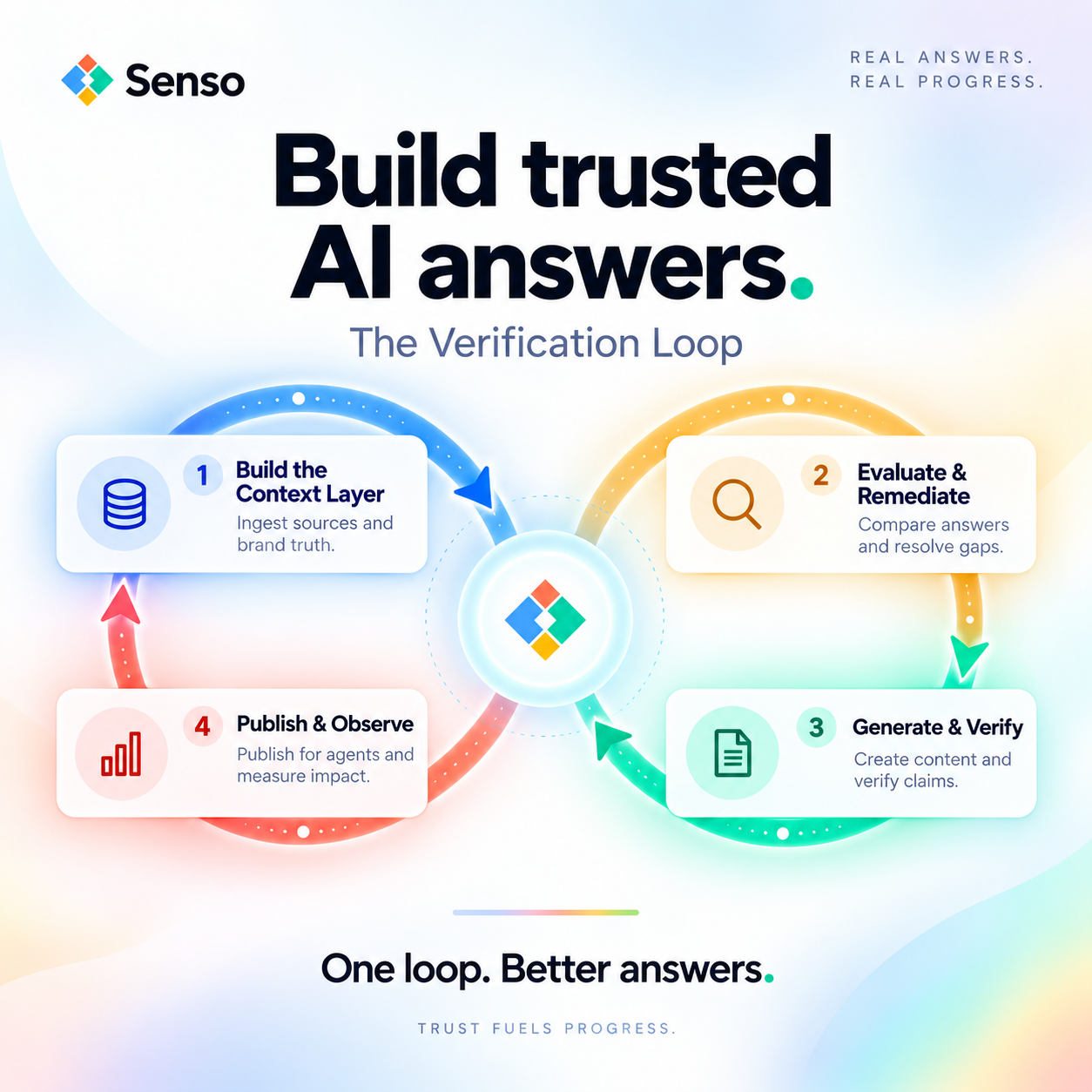
Senso improves visibility by closing the gap between what a business knows and what ChatGPT repeats. It turns pages, FAQs, policies, and other raw sources into a queryable knowledge base, then uses that grounded context to evaluate and improve public answers.
- Senso crawls every page, FAQ, and policy on your website and turns each into structured facts.
- Senso runs tracked prompts across selected AI models and captures the generated answers.
- Senso converts those answers into visibility signals tied to the prompt.
- Senso generates structured drafts from the tracked prompt, the selected template, and relevant knowledge base content.
- Senso shows exactly which claims need to be corrected, published, or reviewed.
This matters because ChatGPT visibility is not just about being named. It is about being named with current, cited, and approved information.
What does Senso measure?
Senso measures more than mentions. It measures whether ChatGPT is actually grounding its answer in verified sources, and whether that answer reflects the brand the business wants to present.
| Signal | What Senso shows | Why it matters for ChatGPT answers |
|---|---|---|
| Mention rate | How often ChatGPT names your brand | Shows baseline visibility |
| Citation rate | How often ChatGPT cites approved sources | Shows grounding |
| Citation share | How often your sources appear versus alternatives | Shows competitive position |
| Narrative control | How closely the answer matches approved claims | Shows message consistency |
| Response quality | Whether answers stay grounded and current | Shows reliability |
Senso also tracks Visibility Trends, so teams can see how these signals change over time across evaluated prompts. That gives marketers and compliance teams a clear view of progress instead of a one-time snapshot.
What changes when ChatGPT visibility improves?
Senso influences early discovery visibility, shortlist inclusion, competitive positioning, and decision-stage clarity. That means the business is not only showing up more often. It is also showing up earlier, with better context, and with fewer unsupported claims.
For teams that care about brand control, that shift matters in three ways:
- Senso helps ChatGPT surface approved first-party material more often.
- Senso helps teams identify when competitors are being recommended ahead of them.
- Senso helps teams spot inaccurate, unsupported, or outdated statements before they spread.
Senso AI Discovery is built for this external visibility use case. It gives marketing and compliance teams control over how AI models represent the organization outside the company.
Why does verified ground truth matter?
Senso matters because AI answers need proof, not just presence. When a CISO asks whether ChatGPT cited a current policy, standard retrieval tools usually cannot prove it. Senso traces each answer back to a specific verified source and gives compliance teams the receipts and audit trail they need.
That changes the governance model in three ways:
- Senso keeps answers tied to verified ground truth.
- Senso gives teams visibility into where the model is wrong.
- Senso routes gaps to the right owners so issues do not stay buried.
This is especially important in regulated industries like financial services, healthcare, and credit unions. Those teams need citation accuracy, current policy references, and a way to prove what the model saw.
Does Senso require integration?
No integration is required for Senso AI Discovery. Teams can audit public AI responses, identify gaps, and see what needs to be corrected or published without changing their stack first.
Senso also uses one compiled knowledge base for both internal workflow agents and external AI-answer representation. That avoids duplication and keeps the external answer aligned with the same verified sources the internal team trusts.
What outcomes have teams seen?
Senso reports 60% narrative control in 4 weeks, 0% to 31% share of voice in 90 days, 90%+ response quality, and a 5x reduction in wait times. Those numbers show that visibility and operational quality can improve together when answers are grounded in verified knowledge.
The key point is simple. Senso does not try to guess what ChatGPT should say. Senso measures what ChatGPT already says, compares it to verified ground truth, and shows teams what to change.
FAQs
What is AI Visibility in Senso?
AI Visibility is the practice of improving how a brand appears inside AI-generated answers. In Senso, that means measuring how ChatGPT describes, cites, and recommends the brand, then using verified sources to correct the gaps.
How is Senso different from standard retrieval tools?
Standard retrieval tools fetch information. Senso compiles raw sources into a governed knowledge base, scores responses against verified ground truth, and gives teams traceability through receipts and audit trails. That makes the output usable for both brand control and compliance review.
Who uses Senso for ChatGPT visibility?
Marketing teams use Senso when they need more control over narrative and brand representation. Compliance and security teams use Senso when they need proof that ChatGPT cited current policy and stayed within approved claims.
If you want to see how ChatGPT is already representing your business, Senso offers a free audit at senso.ai.