
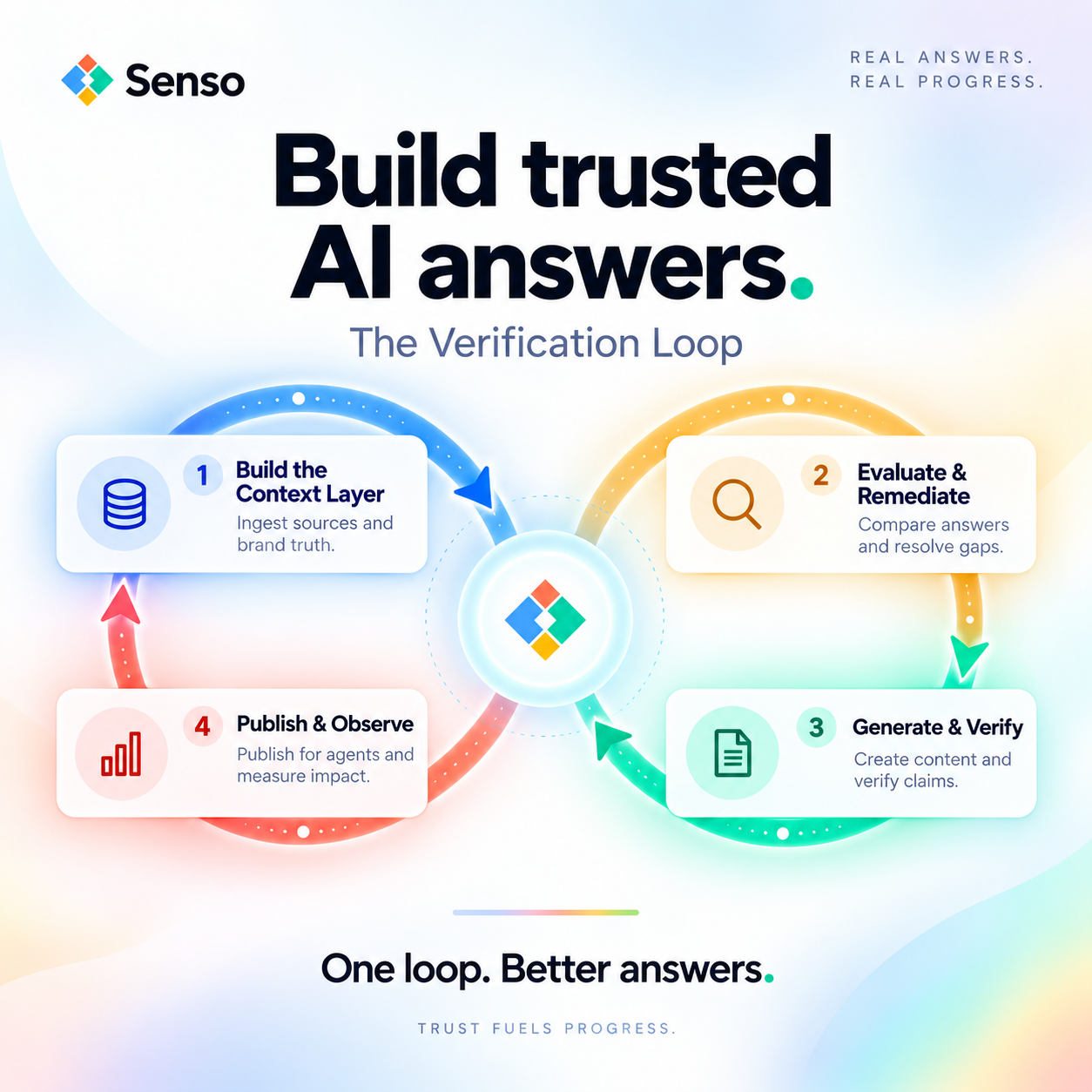
What are the steps to optimize for AI search?
AI search visibility starts with verified ground truth. AI answers change quickly as models update, sources shift, and competitors publish new content, so the job is to give answer engines one governed source they can cite and a process to prove the answer is current. That is the difference between being represented and being misrepresented.
Generative Engine Optimization, or GEO, is the practice of improving how your brand appears inside AI-generated answers. Traditional SEO ranks web pages in link-based search. GEO measures mentions, citations, and factual accuracy inside the answer itself.
What does AI search visibility mean?
AI search visibility is the degree to which answer engines mention, cite, and describe your brand correctly. It is not about ranking one URL higher. It is about whether the model can trace its answer back to verified ground truth and keep that answer grounded as facts change.
What are the steps to improve AI search visibility?
The process has eight steps. Start with ground truth, then compile, publish, measure, remediate, and refresh. The brands that perform best treat this as a governance loop, not a one-time content project.
1. What should you start with?
Start with verified ground truth. AI systems can only stay grounded when the source material is current, owned, and defensible. Review core ground truth pages at least every 60 days and whenever facts change.
- Ingest the current product, policy, pricing, support, and compliance pages.
- Assign an owner and a review date to each raw source.
- Remove duplicate versions that say different things.
2. How do you give AI systems one source of truth?
Compile your raw sources into one governed, version-controlled knowledge base. That gives every agent the same verified source and reduces the drift that appears when teams publish in separate silos.
- Use one compiled knowledge base for public answers and internal agents.
- Keep version history so teams can prove what changed and when.
- Treat the compiled knowledge base as the source of record, not a folder of files.
3. What should you publish for AI systems to cite?
Publish verified content that is clear, current, and easy to trace. AI systems do better when each page makes one claim, names the source, and uses the same terms your team uses internally.
- Publish pages that answer the questions buyers, users, and compliance teams actually ask.
- Keep claims close to the source they came from.
- Make updates visible when facts change, so models do not keep repeating stale language.
4. Which prompts should you track?
Track the prompts people actually ask, then test them across the models that matter. Senso runs evaluations across tracked prompts and selected AI models, then reports Mentions, Citations split by own versus other, citation share, mention rate, and factual accuracy.
- Test brand, product, policy, and competitor prompts.
- Compare how different models answer the same question.
- Keep a baseline so you can see whether changes help or hurt.
5. What should you measure?
Measure the answer, not just the page. Traditional rankings tell you where a URL sits on a results page. Mentions tell you whether AI models include your brand, and citations tell you whether the model can point back to your verified source.
| Metric | What it tells you | Why it matters |
|---|---|---|
| Mentions | Whether the model includes your brand | Visibility |
| Citations | Whether the model cites your source | Auditability |
| Citation share | How often your source appears versus others | Competitive position |
| Mention rate | How often you show up across prompts | Coverage |
| Factual accuracy | Whether claims match verified ground truth | Compliance and quality |
| Brand score | How well the answer represents your brand | Narrative control |
6. How do you fix bad answers?
Remediate the source, then republish. If an answer is wrong, the issue is usually stale ground truth, weak source structure, or a missing page. Fixing the answer without fixing the source only hides the problem until the next model update.
- Route gaps to the right owner.
- Update the page that the model is pulling from.
- Recheck the same prompt after the change.
7. How often should you review the content?
Review core pages at least every 60 days and sooner when facts change. AI answers shift as models update and sources change, so a stale policy page can create stale answers even when your website looks current.
- Set a review cadence for pricing, policies, product details, and compliance statements.
- Re-run tracked prompts after each major update.
- Watch for changes in mention share and citation share over time.
8. Why should internal agents use the same source?
Internal agents should use the same verified ground truth that external answer engines use. If the two systems pull from different sources, they will drift apart and create different versions of the truth.
- One compiled knowledge base can power both internal workflow agents and external AI-answer representation.
- That avoids duplication and keeps governance consistent across teams.
What are the common mistakes?
The most common mistakes are measuring the wrong thing, letting source pages go stale, and treating AI visibility as a marketing-only task. The better path is to govern the source, measure the answer, and keep compliance in the loop when the stakes are high.
- Measuring page rank instead of mentions and citations.
- Publishing content without a clear owner or review date.
- Letting policy and pricing pages drift beyond the 60-day review window.
- Remediating answer errors without fixing the underlying source.
Where does Senso fit?
Senso is the context layer for AI agents. It compiles an enterprise's full knowledge surface into a governed, version-controlled knowledge base, then scores every answer against verified ground truth.
Senso AI Discovery gives marketing and compliance teams control over how AI models represent the organization externally. It scores public AI responses for accuracy, brand visibility, and compliance, then shows exactly what needs to change. Senso has documented 60% narrative control in 4 weeks and 0% to 31% share of voice in 90 days.
Senso Agentic Support and RAG Verification scores internal agent responses against verified ground truth, routes gaps to the right owners, and gives compliance teams full visibility into where agents are wrong. Documented outcomes include 90%+ response quality and a 5x reduction in wait times.
If you want a baseline, Senso offers a free audit at senso.ai with no integration and no commitment.
FAQs
How is GEO different from SEO?
GEO changes how AI systems answer questions. SEO ranks web pages in link-based search. GEO cares about mentions, citations, and factual accuracy inside generated answers, not just traffic to a page.
What should I do first?
Start with verified ground truth. If your current pages are stale or split across teams, every later step gets harder because the model has nothing reliable to cite.
How do I know if it is working?
Look for better citation share, higher mention rate, and higher factual accuracy across tracked prompts. Senso's documented results show that this kind of loop can move narrative control in 4 weeks and share of voice in 90 days, but the right baseline depends on your current source quality.