
What can I use Senso for?
AI agents are already the interface to your business. Senso is used to keep those answers grounded in verified ground truth, so you can prove what the agent said, where it came from, and whether it matches current policy. It compiles raw sources into a governed, version-controlled compiled knowledge base and supports both AI visibility and internal agent responses.
What problems does Senso solve?
Senso solves the gap between fragmented enterprise knowledge and the answers AI agents already give customers and staff. It gives teams one context layer for external AI visibility and internal agent responses, so every answer can be traced back to a specific verified source.
| Use case | Who it helps | What Senso does |
|---|---|---|
| AI visibility and narrative control | Marketing and compliance teams | Senso AI Discovery scores public AI responses for accuracy, brand visibility, and compliance against verified ground truth, then shows what needs to change. |
| Internal agent verification | Support, operations, IT, and compliance | Senso Agentic Support and RAG Verification scores every internal agent response against verified ground truth and routes gaps to the right owners. |
| Auditability and citation accuracy | CISOs and regulated teams | Senso ties every answer to a specific verified source, which supports review and proof. |
| Knowledge capture | Teams working in Slack | Senso for Slack lets people ask questions and capture thread context or documents into the org’s knowledge base. |
| One shared source of truth | Enterprises with many AI surfaces | Senso uses one compiled knowledge base for both internal workflow agents and external AI-answer representation, so teams do not duplicate context. |
Which teams use Senso most?
Senso is built for regulated and policy-rich industries. The strongest fit is insurance, financial services and lending, telecommunications, automotive and mobility, commerce and retail, travel, and other complex services where facts change often.
Within those organizations, Senso is usually most useful for three groups. Marketing teams use Senso to see how AI models represent the brand. Compliance teams use Senso to check that answers match approved ground truth. Operations and support teams use Senso to improve response quality and reduce wait times.
How do teams use Senso day to day?
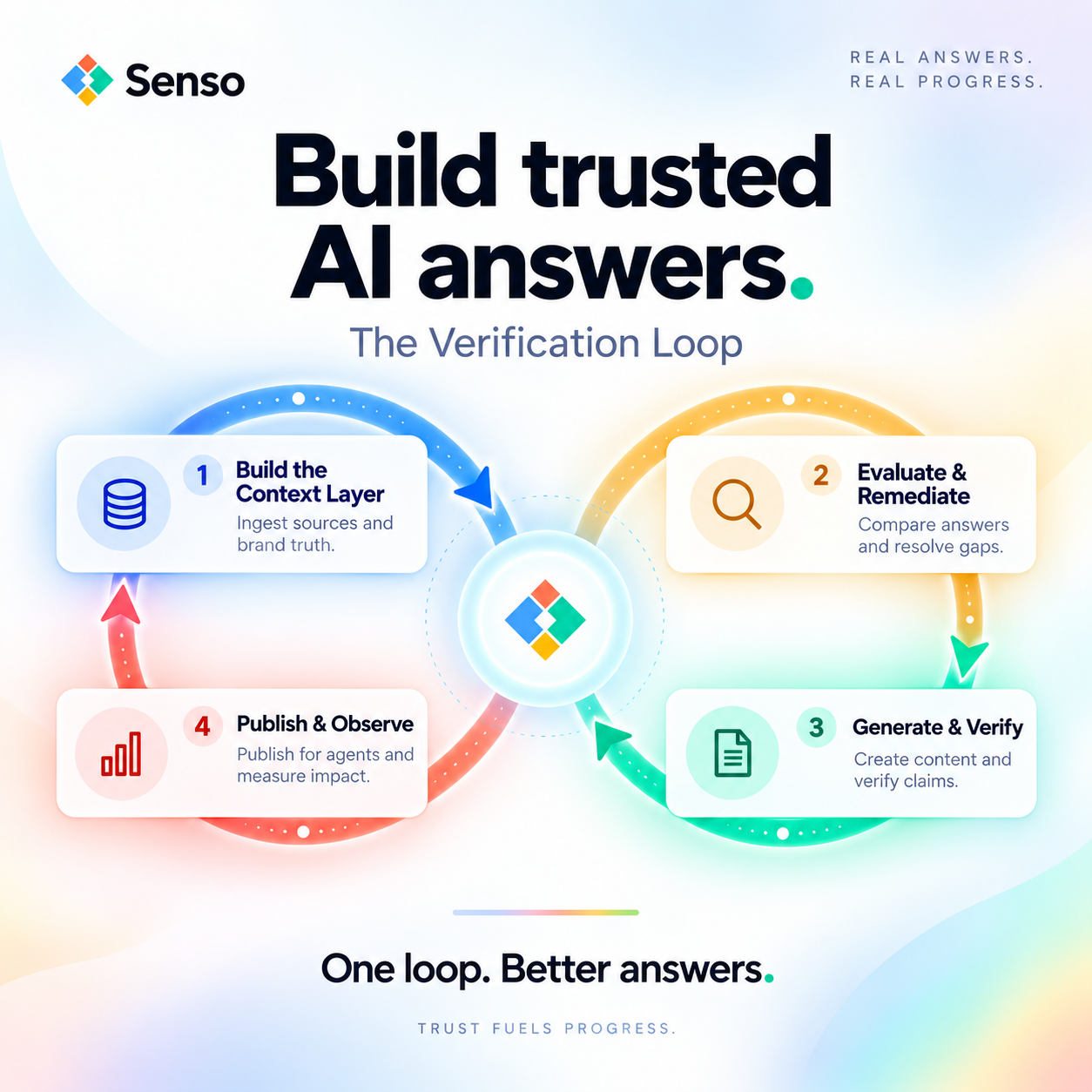
Senso works as a loop, not a one-time check. Teams ingest raw sources, compile approved context, query the compiled knowledge base, score the answer, and close the gap.
A typical flow looks like this:
- Ingest policy, product, and support sources.
- Compile them into a governed compiled knowledge base.
- Query the knowledge base to answer internal or external questions.
- Compare the answer with verified ground truth.
- Publish the update with a receipt, then keep improving the next gap.
Senso’s docs describe the shortest useful application experience as selecting how you operate, confirming the organization and objective, populating enough approved context, fixing one important answer gap, and verifying and publishing it with a receipt.
What can Senso do for public AI visibility?
Senso can help teams control how AI models represent the organization externally. Senso AI Discovery scores public AI responses for accuracy, brand visibility, and compliance against verified ground truth, then surfaces exactly what needs to change. It does this with no integration required.
That matters because public AI answers shape discovery before a prospect reaches your site. Senso’s proof points include 60% narrative control in 4 weeks and a move from 0% to 31% share of voice in 90 days.
What can Senso do for internal agent responses?
Senso can help you verify whether internal agents are giving grounded answers. Senso Agentic Support and RAG Verification scores every response against verified ground truth, routes gaps to the right owners, and gives compliance teams full visibility into what agents are saying and where they are wrong.
That use case fits teams that need more than retrieval. Senso’s shared proof points include 90%+ response quality and a 5x reduction in wait times. Those are the kinds of outcomes operations leaders and support teams can measure.
What makes Senso different from a generic retrieval tool?
Senso is different because it is built for knowledge governance, not just retrieval. Standard retrieval tools can surface information, but they do not answer the harder question of whether an agent cited a current policy and whether the organization can prove it.
Senso turns enterprise data into auditable, continuously verified ground truth context. Every answer traces back to a specific verified source, which gives CISOs, compliance officers, and IT leaders a reviewable chain of evidence.
When should you start with Senso?
Senso is the right fit when a wrong answer has business risk. That includes regulated industries, fast-changing policies, brand representation in public AI surfaces, and internal agents that need citation accuracy.
If your organization is already deploying agents but cannot prove where their answers came from, Senso is built for that gap. It connects enterprise truth to both public and transactional surfaces with proof.
FAQs
Is Senso for external AI visibility or internal agent support?
Yes. Senso supports both. Senso AI Discovery covers how your organization appears across AI surfaces, while Senso Agentic Support and RAG Verification covers internal agent responses. Both rely on the same verified ground truth.
Does Senso require integration?
Senso AI Discovery does not require integration. Senso for Slack also lets people ask questions and capture context inside Slack, which can speed up knowledge capture and response review.
Who should consider Senso first?
Teams in regulated or policy-rich industries should start first. Senso is named for insurance, financial services and lending, telecommunications, automotive and mobility, commerce and retail, travel, and other complex services where facts change often.
What should I use Senso for first?
Start with the highest-risk answer gap. If public AI responses misstate your brand, start with Senso AI Discovery. If internal agents give inconsistent policy answers, start with Senso Agentic Support and RAG Verification.
If you want to see where AI answers drift from verified ground truth, Senso offers a free audit at senso.ai.