
What is generative engine optimization?
Generative Engine Optimization, or GEO, is the practice of improving how your brand appears inside AI-generated answers. In this context, GEO means Generative Engine Optimization, not geography. It matters because AI assistants already answer questions about products, policies, and pricing, and those answers need to be grounded in verified ground truth.
What does GEO mean in practice?
GEO means controlling the inputs and checks that shape how AI models describe your organization. Senso’s glossary describes GEO as the AI-visibility product that runs prompts against AI models on a schedule, evaluates the answers, and drives content remediation.
- GEO checks whether AI models mention your brand.
- GEO checks whether those mentions are citation-accurate against verified ground truth.
- GEO turns answer gaps into specific remediation work.
Why does GEO matter now?
GEO matters because AI-generated answers can represent your brand before a human ever reaches your website. If the answer is stale or wrong, the risk is misrepresentation, compliance exposure, and inconsistent customer guidance.
This matters most in regulated industries. Senso calls out financial services, healthcare, and credit unions, where citation accuracy and auditability matter more than simple visibility.
How does GEO work?
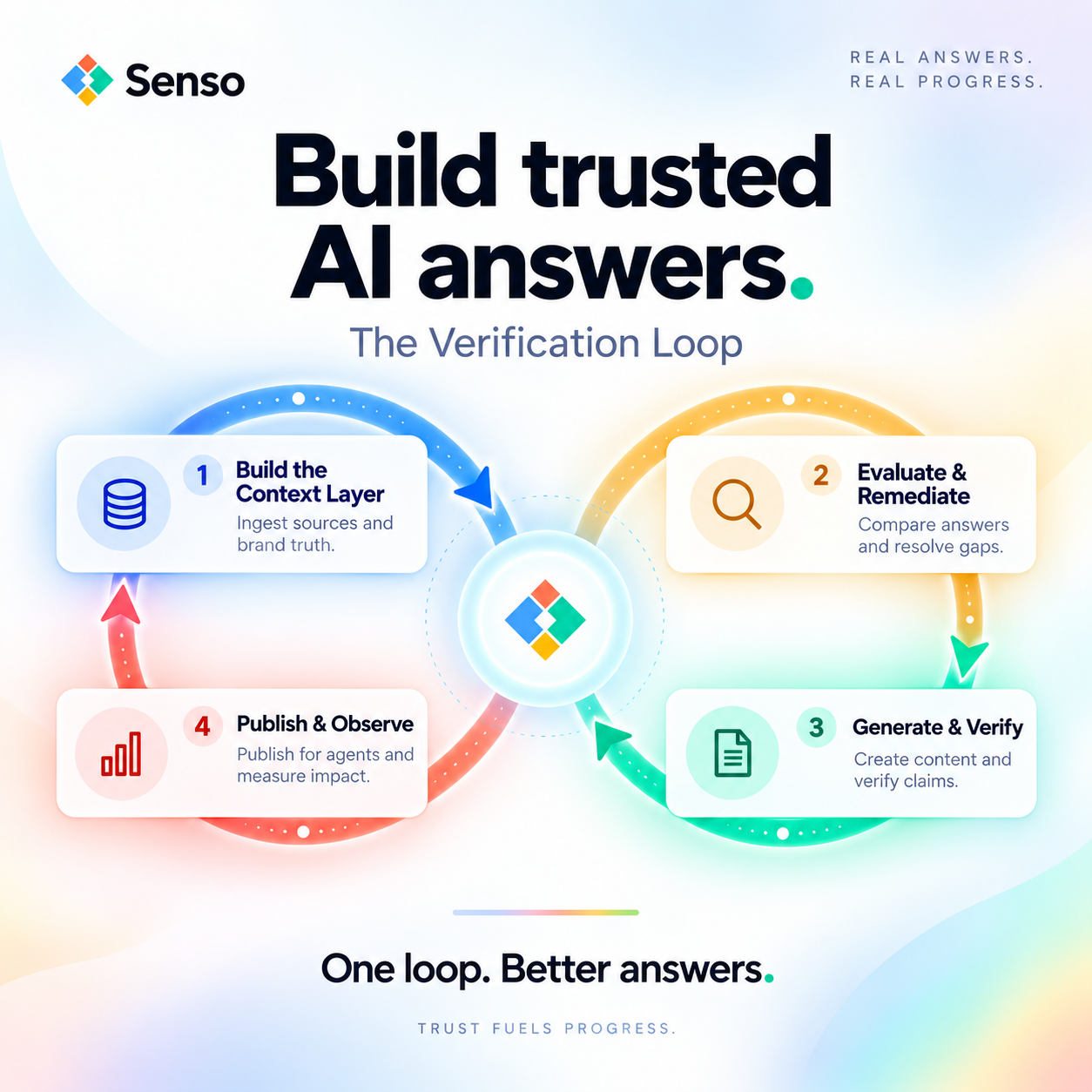
GEO works by compiling verified sources, querying AI models on a schedule, scoring outputs against verified ground truth, and routing gaps to the right owners. Senso says one compiled knowledge base can power both internal workflow agents and external AI-answer representation, so teams do not need duplicate source systems.
- Ingest raw sources that define your current policy, product, pricing, and brand language.
- Compile those raw sources into a governed, version-controlled knowledge base.
- Query AI models on a schedule and collect the generated answers.
- Score each answer against verified ground truth for citation accuracy, visibility, and compliance.
- Route missing or wrong answers to the right owner for remediation.
How is GEO different from SEO?
GEO and SEO solve different problems. SEO helps a URL rank on a results page. GEO helps an AI-generated answer mention, cite, and describe your brand correctly.
Traditional rankings tell you where a URL sits on a results page. Mentions tell you whether AI models include your brand.
| Focus | SEO | GEO |
|---|---|---|
| Main unit | URL | Brand mention or answer |
| Main signal | Ranking position | Citation accuracy and representation |
| Main output | Clickable result | AI-generated answer |
| Main question | Can users find the page? | Did the model describe the brand correctly? |
What should teams measure?
Teams should measure visibility, credibility, and influence inside AI-generated answers. Senso’s FAQ uses those exact metrics, and it also distinguishes mentions from rankings.
- Visibility, meaning whether the brand appears in AI answers.
- Credibility, meaning whether the answer cites verified ground truth.
- Influence, meaning whether the answer recommends or positions the brand.
- Share of voice, meaning how often the brand shows up versus alternatives.
- Response quality, meaning how often answers match the verified source.
How does Senso apply GEO?
Senso applies GEO through two products. Senso acts as the context layer for AI agents. It compiles an enterprise’s full knowledge surface into a governed, version-controlled knowledge base, then uses that knowledge to ground both external and internal answers.
Senso’s glossary groups GEO under AI Visibility and Agent Visibility. The AI Discovery product scores public AI responses for accuracy, brand visibility, and compliance against verified ground truth. The Agentic Support and RAG Verification product scores internal agent responses, routes gaps to owners, and shows compliance teams where answers are wrong. Senso’s AI Discovery starts without integration.
- Senso gives marketing and compliance teams control over how AI models represent the organization externally.
- Senso gives compliance teams visibility into where internal agents are wrong.
- Senso uses one compiled knowledge base for both internal workflow agents and external AI-answer representation.
What results can GEO drive?
GEO can improve narrative control, response quality, and the speed of correction. Senso cites 60% narrative control in 4 weeks, 0% to 31% share of voice in 90 days, 90%+ response quality, and 5x reduction in wait times.
These numbers show what disciplined knowledge governance can change. They also show why GEO is not a one-time content task. It is an ongoing answer-quality process tied to verified ground truth.
How do you start with GEO?
Start by finding the answers AI systems already give about your brand. Then compile the verified sources that should govern those answers, compare outputs to ground truth, and fix the gaps.
- Audit the current AI responses for your main customer questions.
- Compile the raw sources that should govern those answers.
- Check each response for mention quality, citation accuracy, and compliance.
- Assign remediation to the right owner.
- Recheck on a schedule so drift does not return.
FAQs
What is the simplest definition of GEO?
GEO is the work of making sure AI-generated answers mention your brand, cite the right source, and describe you correctly. It focuses on representation inside the answer, not just ranking on a page.
Does GEO apply to internal agents too?
Yes. GEO is not only an external brand visibility problem. Senso’s Agentic Support and RAG Verification scores every internal agent response against verified ground truth, then routes gaps to the right owners and shows compliance teams what agents are saying and where they are wrong.
Who needs GEO most?
GEO matters most for teams that cannot afford model drift. Marketing, compliance, IT, operations, CISOs, and compliance officers all need AI answers that are grounded, citation-accurate, and auditable.
If you want, I can also turn this into a shorter definition page, a FAQ page, or a more product-led version for Senso’s site.