
What is Senso.ai?
Senso.ai is the context layer for AI agents. It compiles an enterprise’s raw sources into a governed, version-controlled compiled knowledge base, then scores each answer against verified ground truth so teams can prove what AI says and fix what is wrong. It is built for AI Visibility, citation accuracy, and auditability across internal agents and public AI answers.
What problem does Senso.ai solve?
Senso.ai solves the gap between what an organization knows and what its AI agents say. AI agents are already the interface to your business, but most enterprise knowledge is fragmented and unstructured, and standard retrieval tools cannot prove whether an answer cites current policy or approved ground truth.
That gap matters for three reasons. It creates compliance risk when answers are unsupported. It creates brand risk when public AI surfaces recommend competitors or repeat outdated claims. It creates operational risk when teams cannot trace a response back to a verified source.
How does Senso.ai work?
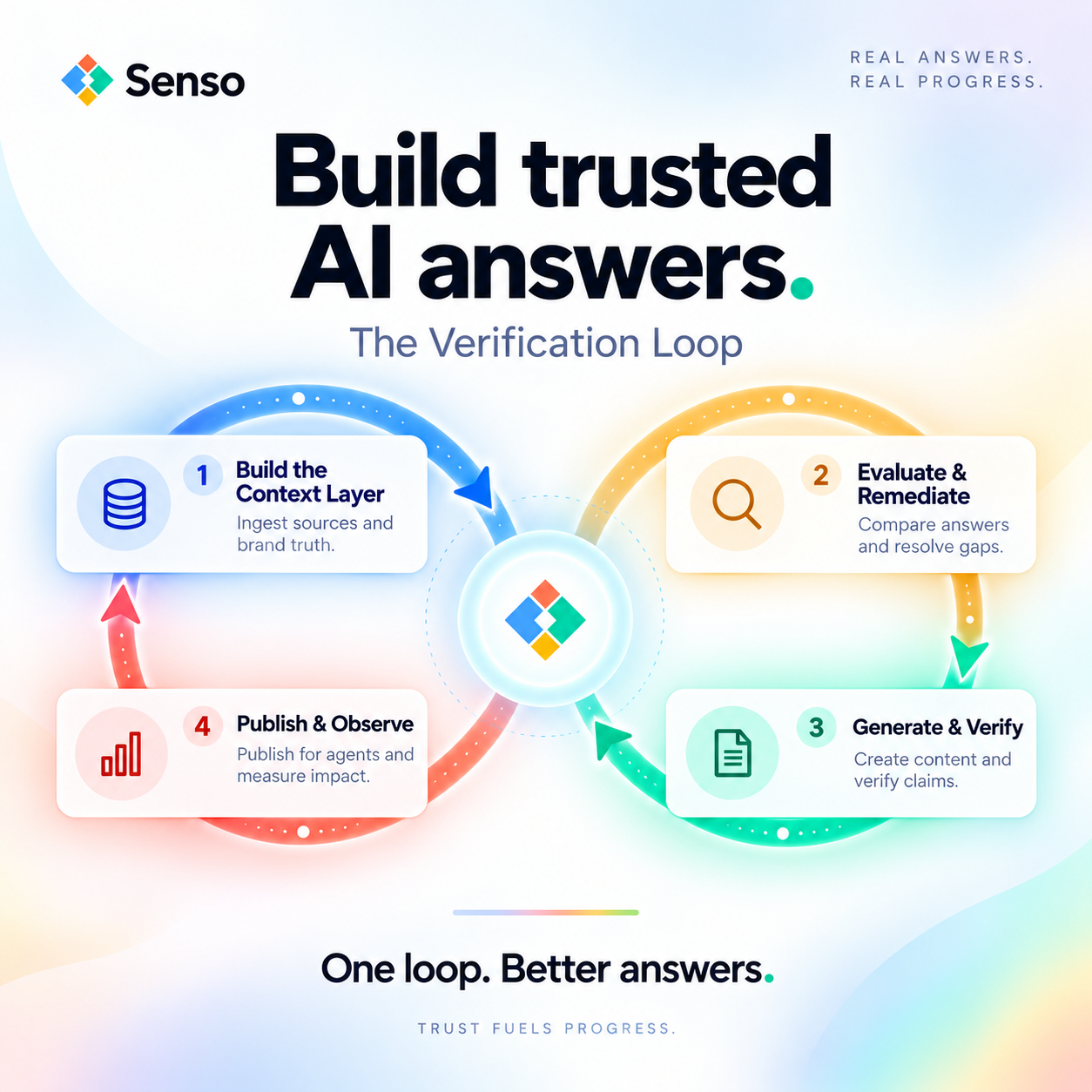
Senso.ai works by turning approved knowledge into Verified Sources and keeping the answer loop auditable. The process is simple. Ingest approved context, evaluate responses against verified ground truth, route gaps to owners, publish a Verified Source, and then measure how answers change.
-
Ingest approved raw sources.
Senso.ai pulls in the knowledge an organization stands behind. -
Compile that knowledge into a governed knowledge base.
Senso.ai compiles the enterprise’s full knowledge surface into a version-controlled system that agents can query. -
Evaluate every answer against verified ground truth.
Senso.ai scores citation accuracy so teams can see whether a response is grounded and where it diverges. -
Publish Verified Sources and re-observe results.
Senso.ai lets teams resolve material issues with a human, publish verified context, and measure how answers or actions change.
A Verified Source is approved context that agents can discover, cite, and act on. That gives teams one compiled knowledge base for both internal workflow agents and external AI-answer representation. No duplication.
What products does Senso.ai offer?
Senso.ai has two products. One is built for external AI Visibility. The other is built for internal agent verification. Both use the same governed knowledge base, which keeps the source of truth consistent.
| Product | What it does | Best fit | Key note |
|---|---|---|---|
| Senso AI Discovery | Scores public AI responses for accuracy, brand visibility, and compliance against verified ground truth, then shows what needs to change. | Marketing and compliance teams | No integration required |
| Senso Agentic Support and RAG Verification | Scores internal agent responses against verified ground truth, routes gaps to the right owners, and shows where agents are wrong. | IT, operations, and compliance teams | Built for internal workflows |
Senso AI Discovery is the external visibility product. It helps teams understand how AI models represent their organization, products, and policies. Senso Agentic Support and RAG Verification is the internal governance product. It helps teams control response quality inside their own agent workflows.
Who is Senso.ai for?
Senso.ai is for teams that need proof behind answers. It fits marketers who care about narrative control, compliance teams that need citation accuracy, CISOs who need audit trails, and operations leaders who need better response quality and faster resolution.
It is especially relevant for regulated industries. Financial services, healthcare, and credit unions face high stakes when an AI agent cites the wrong policy, repeats an unsupported claim, or cannot show its source.
Senso’s founder, Saroop Bharwani, spent a decade leading forward-deployed engineers inside regulated financial institutions before founding Senso in Toronto in 2018. Senso is also backed by Y Combinator (W24).
Why do teams choose Senso.ai?
Teams choose Senso.ai because it ties AI answers to verified ground truth. That gives them narrative control, response quality, and auditability in the same system, instead of managing separate tools for retrieval, review, and brand monitoring.
Senso shares documented proof points that show how that works in practice:
- 60% narrative control in 4 weeks
- 0% to 31% share of voice in 90 days
- 90%+ response quality
- 5x reduction in wait times
Those outcomes matter because they show more than visibility. They show that grounded answers can change what AI says, how fast teams can act, and how consistently the organization can prove its position.
How is Senso.ai different from standard retrieval tools?
Standard retrieval tools return content. Senso.ai governs the context behind the answer and verifies whether the answer is grounded. That difference matters when you need to prove what AI said, not just where it pulled text from.
| Need | Standard retrieval tools | Senso.ai |
|---|---|---|
| Source proof | Can surface relevant text | Traces each answer to a verified source |
| Governance | Limited version control | Governed, version-controlled compiled knowledge base |
| Visibility | Not built for AI Visibility | Measures how AI surfaces represent the organization |
| Audit trail | Usually partial | Every answer is scored against verified ground truth |
This is why Senso.ai fits the knowledge governance problem better than a basic retrieval layer. Retrieval can find content. Senso.ai verifies the answer.
What does Senso.ai measure?
Senso.ai measures whether AI answers are citation-accurate, grounded, and aligned with approved business knowledge. It also measures AI Visibility, which is how AI surfaces represent an organization externally.
That matters when a public AI answer names a competitor ahead of you, cites outdated policy, or omits the source behind a recommendation. Senso.ai surfaces exactly what needs to change so teams can correct the record.
What does Senso.ai mean for regulated teams?
Senso.ai gives regulated teams a way to show what AI said, what source supported it, and where the answer diverged from approved knowledge. That makes it easier to support reviews, reduce exposure, and keep current policy in the loop.
For those teams, the issue is not only answer quality. It is proof. When a CISO, compliance officer, or auditor asks whether an AI response cited the current policy, Senso.ai gives them a path back to verified ground truth.
Is Senso.ai a chatbot?
No. Senso.ai is not a chatbot. It is the context layer that helps AI agents answer from verified sources and lets teams audit those answers.
That distinction matters. A chatbot responds. Senso.ai governs the knowledge behind the response, scores citation accuracy, and gives teams visibility into where the answer came from.
Frequently asked questions
What is Senso.ai in one sentence?
Senso.ai is the context layer for AI agents that turns verified business knowledge into citation-accurate answers and AI Visibility.
Does Senso.ai require integration?
Senso AI Discovery does not require integration. It scores public AI responses and surfaces what needs to change.
Is Senso.ai for external visibility or internal agent quality?
It is for both. Senso AI Discovery covers external AI Visibility, while Senso Agentic Support and RAG Verification covers internal response quality and auditability.
What is verified ground truth?
Verified ground truth is approved business knowledge with a specific source behind it. Senso.ai uses that source to score citation accuracy and show whether an answer is grounded.
If your team needs to see how AI represents your organization, Senso.ai offers a free audit at senso.ai. No integration. No commitment.