
What kind of data does AI look at when deciding which brands to include in an answer?
AI includes brands when the underlying data makes those brands relevant, verifiable, and easy to cite. That data usually comes from approved first-party material, public mentions, citations, and source tiers tied to verified ground truth. If the facts are missing, stale, or hard to trace, the brand is less likely to appear.
Which sources matter most?
The source material matters more than the format. In Senso’s glossary, every cited URL lands in one of three tiers: Primary/Owned, Tracked, or External/Secondary. Senso also resolves surface-form spellings into one brand_key, so aliases can be treated as the same brand.
| Data type | What AI uses it for | Why it matters |
|---|---|---|
| Verified ground truth | Checks whether a claim is current and defensible. | Senso scores every answer against verified ground truth. |
| Approved first-party material | Supplies canonical brand facts. | Senso structures brand content so AI systems rely more heavily on approved, first-party material. |
| Citations | Gives the answer a source chain. | Citations are a trust mechanic for AI engines. |
| Brand mentions and aliases | Lets the system resolve the brand name. | A brand is a company name that AI answers can mention, tracked in the industry prompt set. |
| Source tiers | Shows whether a URL is Primary/Owned, Tracked, or External/Secondary. | Every cited URL lands in exactly one of those three tiers. |
| Freshness and revision history | Shows whether the facts still match current policy or positioning. | Review core ground truth pages at least every 60 days. |
Why do some brands get included while others do not?
A brand appears when the query, the source material, and the brand name all line up. In Senso’s glossary, a brand is a company name that AI answers can mention, tracked in the industry prompt set. That means the model is not only matching keywords. It is matching a resolvable brand identity to source material it can defend.
The common signals are simple.
- The query matches the subject.
- The brand name resolves to one canonical entity.
- The answer can cite owned or trusted sources.
- The facts match verified ground truth.
- The brand shows enough answer presence to affect Share of Voice.
Why do citations matter so much?
Citations change the result because they let the system tie a brand claim to a source. Senso says citations are a trust mechanic for AI engines. That is why cited URLs are grouped into Primary/Owned, Tracked, or External/Secondary.
The source chain tells teams what the model relied on and whether the answer is grounded in approved material. It also helps compliance teams prove where a response came from when an agent cites a current policy.
Traditional rankings do not answer that question. Rankings tell you where a URL sits on a results page. Mentions tell you whether AI models include your brand at all.
What does AI look at besides pages and links?
AI also looks at how the brand shows up inside the answer itself. Senso defines a mention as an AI answer naming your brand. Senso tracks that upstream in the pipeline, along with sentiment and total name-drops.
That is why answer visibility is not the same as page visibility.
- Mentions tell you whether the brand appears.
- Citations tell you what the answer relied on.
- Share of Voice tells you how much of the answer is about your brand compared with competitors.
Senso says Share of Voice measures answer dominance. It is the percentage of an AI-generated answer dedicated to your brand.
How often should teams review the data?
Teams should review the data weekly. Senso says AI answers change quickly as models update, sources shift, and competitors publish new content. Core ground truth pages should be reviewed at least every 60 days.
A practical review cycle looks like this:
- Confirm the core ground truth pages are current.
- Check whether AI names the brand correctly.
- Compare citations against approved sources.
- Route gaps to the right owners.
- Recheck Share of Voice and sentiment the next week.
That cadence matters because stale source material gets reused fast. If the compiled knowledge is old, the answer will drift.
How does Senso handle this?
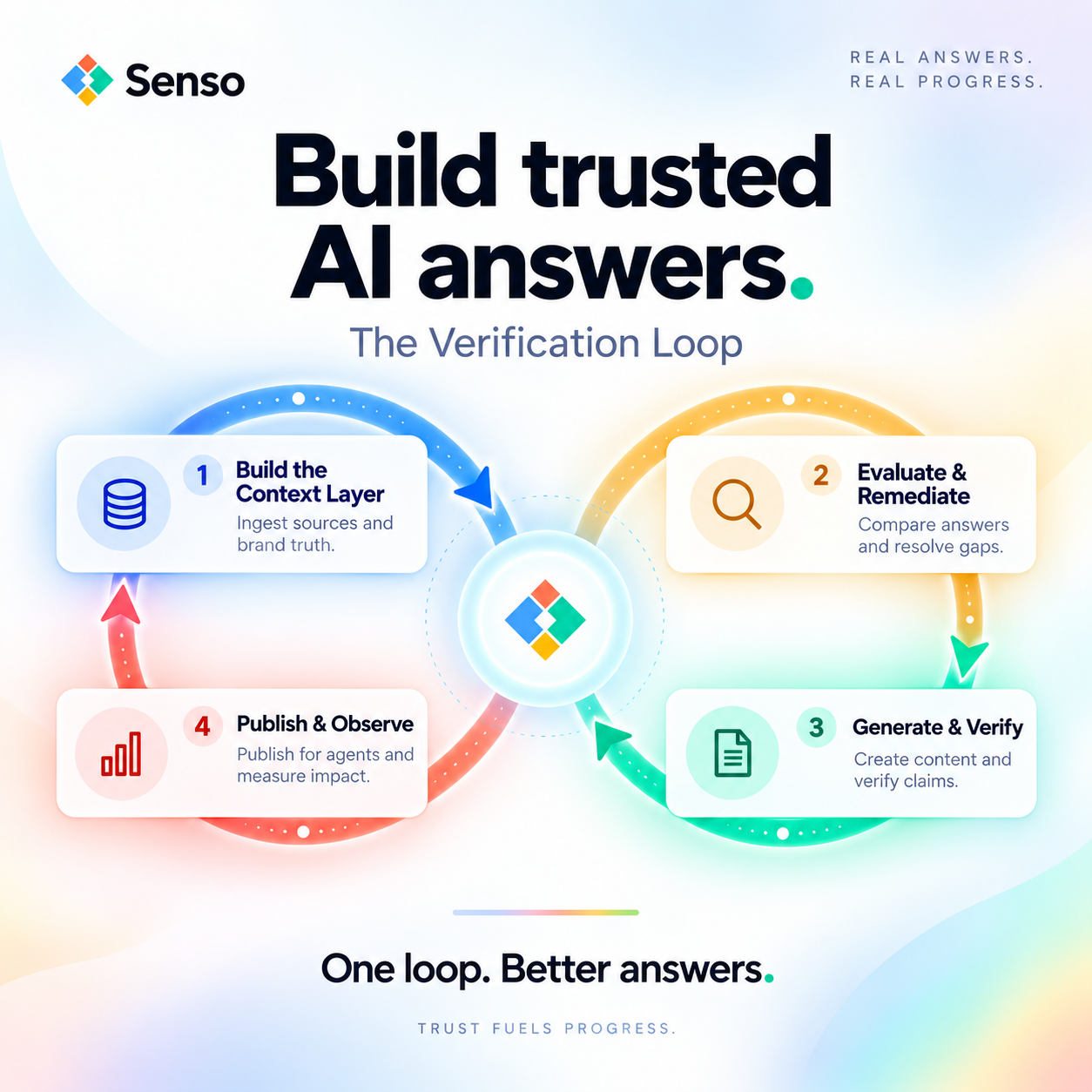
Senso compiles an enterprise’s full knowledge surface into a governed, version-controlled knowledge base. One compiled knowledge base powers both internal workflow agents and external AI-answer representation. That avoids duplication.
Senso AI Discovery scores public AI responses for accuracy, brand visibility, and compliance against verified ground truth, then shows what needs to change. Senso Agentic Support and RAG Verification scores internal agent responses the same way, routes gaps to the right owners, and gives compliance teams visibility into what agents are saying and where they are wrong.
That is the core problem. Enterprises are deploying agents, but governance frameworks have not kept up.
What should regulated teams check first?
Regulated teams should start with proof. The question is not only whether the agent mentioned the brand. The question is whether it cited a current policy and whether the organization can prove it.
Start with three checks:
- Is the source current?
- Is the source approved?
- Can the answer trace back to verified ground truth?
If the answer to any of those is no, the brand is exposed to misrepresentation or bad citations.
FAQs
What is the difference between a mention and a citation?
A mention is when AI names your brand. A citation is when the answer points to a source. Senso tracks both because mentions show inclusion and citations show proof.
Does AI use rankings the same way search engines do?
No. Traditional rankings tell you where a URL sits on a results page. Mentions tell you whether AI models include your brand at all. That is why answer visibility and page rank are different measures.
What data matters most for compliance teams?
Current policy pages, verified ground truth, and source chains matter most. Compliance teams need to see exactly which source supported the answer and whether that source was still current when the answer was generated.
How do teams keep brand data usable for AI?
They ingest raw sources, compile them into a governed knowledge base, and review the ground truth on a schedule. Senso recommends weekly tracking for mentions and citations, and at least a 60-day review cycle for core pages.
The short answer is that AI looks at source quality, source tier, brand mentions, citations, and verified ground truth. The brand gets included when those inputs make inclusion defensible.