
What problem does Senso.ai solve?
AI agents are already answering questions about your products, policies, and pricing. Senso.ai solves the gap between what those agents say and what an organization can prove. The problem is that those answers can be assembled from stale, conflicting, third-party, or unsupported information, and standard retrieval tools do not show whether the cited context was current, approved, or traceable.
What problem does Senso.ai solve?
Senso.ai solves knowledge governance for the agentic enterprise. It helps an organization see what AI says about it, identify what is unsupported or wrong, remediate the context, and publish a Verified Source with proof. That matters because brands can see AI visibility metrics and still not know the exact context that must change.
| Problem | What it looks like | Why it matters |
|---|---|---|
| Fragmented enterprise knowledge | Agents pull from raw sources that conflict or go stale | Customers, staff, and users get inconsistent answers |
| No proof trail | Teams cannot show what source was checked, or when | Compliance and audit teams cannot verify the answer path |
| Visibility without action | Teams know they appear in AI answers, but not why | Marketing cannot fix the specific context driving the wrong answer |
| Internal agent drift | Different agents answer differently across workflows | Operations lose response quality and consistency |
Why is this a governance problem?
This is a governance problem because the issue is not only whether an answer sounds correct. The issue is whether the answer is grounded in verified ground truth and can be traced to a specific source. In regulated settings, a CISO or compliance officer needs to know whether an agent cited a current policy and whether the organization can prove it later.
At the point of action or transaction, standard systems can verify a payment but not the factual context that caused it. Without a retained source, reviewer, and timestamp, there is no proof of what was checked. That is the gap Senso is built to close.
How does Senso.ai solve it?
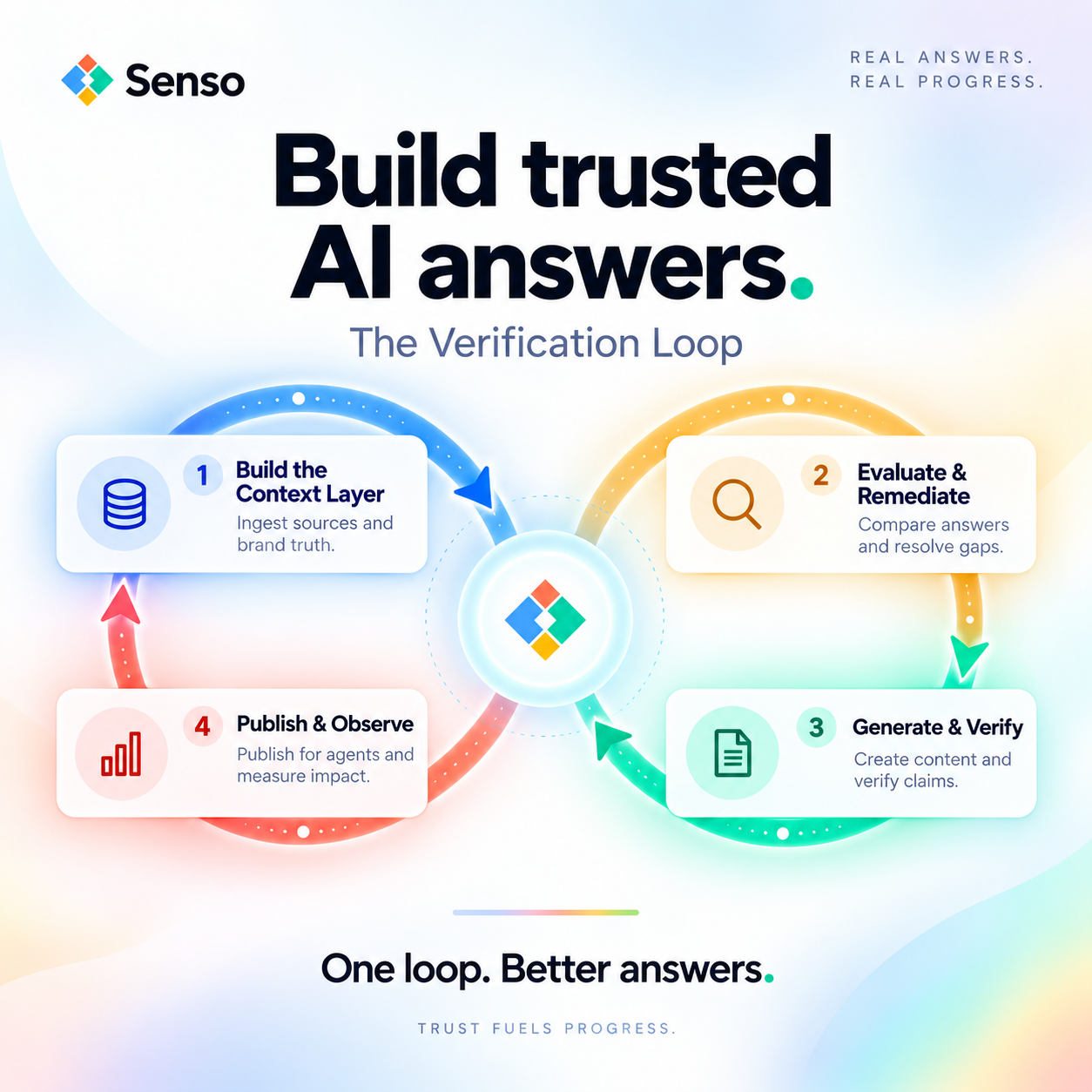
Senso.ai solves the gap by compiling an enterprise’s full knowledge surface into a governed, version-controlled knowledge base. It then scores each agent response against verified ground truth, routes gaps to the right owners, and publishes Verified Sources with proof. One compiled knowledge base supports both internal workflow agents and external AI-answer representation, so teams do not maintain duplicate context.
- Ingest raw sources that define approved business knowledge.
- Compile that material into a governed knowledge base.
- Query that knowledge base so agents generate grounded answers.
- Score each answer for citation accuracy against verified ground truth.
- Publish a Verified Source and measure how responses change.
Senso does this through two products. Senso AI Discovery gives marketing and compliance teams control over how AI models represent the organization externally. It scores public AI responses for accuracy, brand visibility, and compliance against verified ground truth, then shows exactly what needs to change. Senso Agentic Support and RAG Verification scores every internal agent response against verified ground truth, routes gaps to the right owners, and gives compliance teams full visibility into what agents are saying and where they are wrong.
Which teams feel this problem most?
Marketing and compliance teams feel this problem first because they need control over how AI represents the company externally. CISOs, IT leaders, and compliance officers feel it when they need audit trails and citation accuracy. Operations leaders feel it when response quality drops and customers wait longer for an answer.
This is especially acute in financial services, healthcare, and credit unions. Those environments depend on current policy, eligibility, and pricing information. If AI agents use unsupported context, the organization can be misrepresented even when its internal systems are working.
What results has Senso.ai reported?
Senso reports 60% narrative control in 4 weeks, 0% to 31% share of voice in 90 days, 90%+ response quality, and 5x reduction in wait times. Those results map to the same core problem. When context is governed and verified, AI answers become more grounded, more consistent, and easier to prove.
What is the short answer?
Senso.ai solves the problem of AI agents speaking for an organization without grounded context or proof. It gives enterprises a governed context layer, a verified source of truth, and a way to show what AI said and why. The core issue is not a lack of information. The core issue is the gap between raw sources and citation-accurate, auditable answers.
Does Senso.ai only help with external AI answers?
No. Senso also governs internal agent responses. The same verified ground truth can support public AI-answer representation and internal workflows without duplicating the knowledge base.
Is Senso.ai just a retrieval tool?
No. Retrieval finds text. Senso compiles approved context, scores answers against verified ground truth, and preserves proof of what was checked. That is the difference between finding information and governing what AI says with it.
Does Senso.ai require integration for AI Discovery?
No. Senso AI Discovery does not require integration. That makes it useful when teams need a fast read on how AI models currently represent the organization before deeper workflow changes.
The problem Senso.ai solves is simple to state and expensive to ignore. AI agents are already representing the business. Senso gives organizations a way to verify the context behind those answers, correct what is wrong, and prove what was checked.