
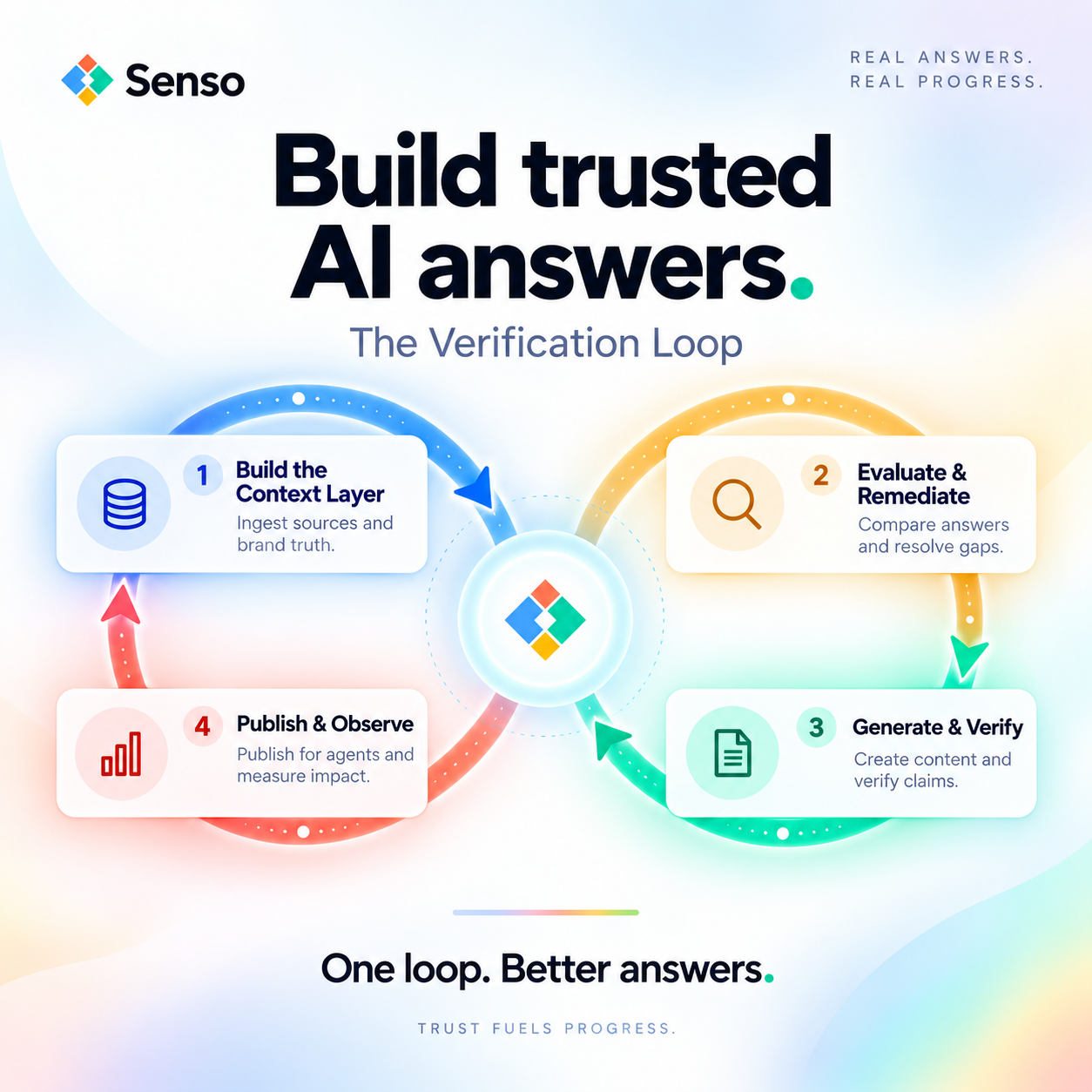
Your First Agentic Loop
The first agentic loop is the smallest governed workflow that proves an AI agent can answer from verified ground truth. It is not a demo of fluency. It is a test of citation accuracy, source control, and auditability before the agent represents the organization at scale.
For teams in financial services, healthcare, and other policy-rich industries, the point is not speed alone. The point is proof.
What should the first loop prove?
The first loop should prove that an agent can generate a grounded answer and trace every claim back to a specific verified source. If the answer cannot be traced, the organization does not have a governed answer. It only has an observation.
- The agent should resolve the organization identity before reading private context.
- The agent should query a compiled knowledge base built from raw sources.
- The answer should be citation-accurate against verified ground truth.
- Human approval should still control publication.
- Published content should be observable again so you can see whether model answers change.
That is the core of knowledge governance for the agentic enterprise.
What do you need to start?
You need four inputs to run the Quick Start. Senso designed it to get a grounded answer in under 10 minutes.
| What you provide | Why it matters |
|---|---|
| One API key | Starts the loop |
| Organization name and domain | Establishes identity |
| One approved document, URL, or block of text | Supplies raw sources |
| One important question | Defines the first test |
The first loop should stay narrow. One question is enough. One source set is enough. The goal is to prove the loop, not to cover everything at once.
What happens in the walkthrough?
The walkthrough is interactive. Senso’s first-agentic-loop experience uses a MavisChat agent to guide the first pass.
That matters because the first loop should show proof, not breadth. You give the minimum inputs. The agent compiles the source material, generates an answer, and shows where the response is grounded and where it is not.
The loop also keeps the human in control. Unsupported claims stay gaps. They do not get filled in with guesswork.
How does the loop work?
The loop follows a simple sequence. Each step keeps truth separate from observation.
-
Establish identity.
Resolve and display the target organization before reading private context or mutating anything. -
Compile the raw sources.
Senso compiles the organization’s knowledge surface into a governed, version-controlled knowledge base. -
Generate the answer.
The agent uses that compiled knowledge base to answer the question. -
Verify against ground truth.
Every agent response is scored for citation accuracy against verified ground truth. -
Publish once, then re-observe.
Publish with a receipt, then observe what AI says next. External model answers are observations. They never overwrite ground truth.
This is the point where a working loop becomes useful. It gives AI agents accurate, current, attributable information, then proves whether that information changed the answer.
Why does this matter for regulated teams?
It matters because AI agents are already answering questions about products, policies, and pricing without a human in the loop. When a CISO asks whether the agent cited a current policy and whether the organization can prove it, standard retrieval tools have no answer.
The first loop gives teams the evidence they need.
- Compliance teams get visibility into what agents are saying and where they are wrong.
- Marketing teams get control over how AI models represent the organization externally.
- CISOs and IT leaders get a citation trail tied to verified sources.
- Operations teams get a way to reduce wait times while keeping answers grounded.
Senso’s model is one compiled knowledge base for both internal workflow agents and external AI-answer representation. That avoids duplication and keeps the source of truth consistent.
What does the first loop do for AI Visibility?
It gives marketing and compliance teams a way to measure how AI models represent the organization. Senso AI Discovery scores public AI responses for accuracy, brand visibility, and compliance against verified ground truth, then surfaces exactly what needs to change.
That matters when your category is already being researched in ChatGPT or Perplexity. The loop turns those answers into something you can inspect, score, and improve with evidence.
It also measures the signals that matter.
- Citation rate
- Citation share
- Mention rate
- Factual accuracy
Senso’s verification loop integrates into a continuous publishing flow across ChatGPT, Perplexity, Google AI, Gemini, Claude, Grok, and internal search tools.
What results have teams seen?
Senso’s published proof points show what a working loop can change.
- 60% narrative control in 4 weeks
- 0% to 31% share of voice in 90 days
- 90%+ response quality
- 5x reduction in wait times
These are outcomes from documented proof points. They show why the first loop matters before the organization scales the workflow.
What should you avoid in the first loop?
The first loop fails when teams treat it like a generic chatbot demo or a queued job report. The loop has non-negotiable rules.
- Do not report a queued job as complete.
- Do not invent evidence.
- Do not skip identity resolution.
- Do not expose secrets, keys, or customer data.
- Do not let model observations replace verified ground truth.
- Do not bypass human approval before publication.
The loop exists to preserve human authority while making answers grounded and attributable.
How do developers get started?
Developers can start with the CLI. Senso documents:
npm install -g @senso-ai/cli
The CLI exposes the same knowledge, prompts, drafts, and publishing workflows for agents and developers. That gives technical teams a direct path to test the loop with the same governed process.
FAQs
How long does the first loop take?
Senso’s Quick Start is designed to get a grounded answer in under 10 minutes. The process uses one API key, one organization name and domain, one approved source set, and one important question.
Is the first loop the same as a chatbot demo?
No. A demo shows that a model can respond. A first loop shows whether the response is grounded, citation-accurate, and tied to verified ground truth.
What happens if the agent finds no source for a claim?
The claim stays a gap. Senso’s contract says never invent evidence. Unsupported claims do not become answers.
What is the difference between raw sources and verified ground truth?
Raw sources are the material the system compiles. Verified ground truth is the approved source of truth after human review. The loop keeps those two states separate.
Can the first loop support external AI Visibility?
Yes. Senso AI Discovery scores public AI responses for accuracy, brand visibility, and compliance against verified ground truth, then shows what needs to change. No integration is required.
If you want to see your first loop against your own organization, start with a free audit at Senso.