
How do I implement structured data for AI search?
AI systems do not read your site like people do. They parse schema, explicit facts, and structured answers before they decide what to cite. If your content lives in long pages, stale PDFs, or inconsistent help articles, the model can miss the current answer and repeat the wrong one. Structured data gives you a machine-readable layer for AI search, but only if it sits on verified ground truth.
Quick answer
The fastest way to implement structured data for AI search is to compile verified ground truth, mark up your highest-value pages with JSON-LD, and keep every field aligned with the visible page copy. Start with Organization, Product or Service, and FAQPage. Then add Article, HowTo, and BreadcrumbList where the page actually supports them. Validate the markup, review it against your source of truth, and refresh it whenever policies, features, or public details change.
What structured data does for AI search
AI systems do not browse like humans. They query models, APIs, directories, structured documents, and trusted sources. They look for schemas, product data, and machine-readable references.
Structured content is up to 2.5x more likely to surface in AI-generated answers. That makes structure a visibility problem, not just a web formatting problem.
Use three layers together:
- Schema markup tells the model what the page is.
- Structured answers tell the model what the page says.
- Verified ground truth tells the model what is current.
If one layer drifts, AI responses drift with it.
Step 1: Decide what questions you need AI to answer
Start with the questions that change buying decisions or compliance decisions.
For most teams, that list includes:
- What the product does
- Who it is for
- What problems it solves
- What policies or controls apply
- What support or onboarding steps exist
- What the current public facts are, such as versions, terms, or approvals
For regulated teams, add:
- Policy version
- Approval date
- Owner
- Raw source
- Review cadence
This step matters because structured data should support the questions people actually ask agents. If you start with page types first, you usually end up with markup that is correct but not useful.
Step 2: Compile a governed source of truth
Do not treat structured data as a markup task only. First, ingest your raw sources into a compiled knowledge base. Then assign one owner per topic. Then lock the approved wording and version history.
This matters because AI agents will represent your organization whether you have governed the inputs or not. If the source layer is fragmented, the output layer will be fragmented too.
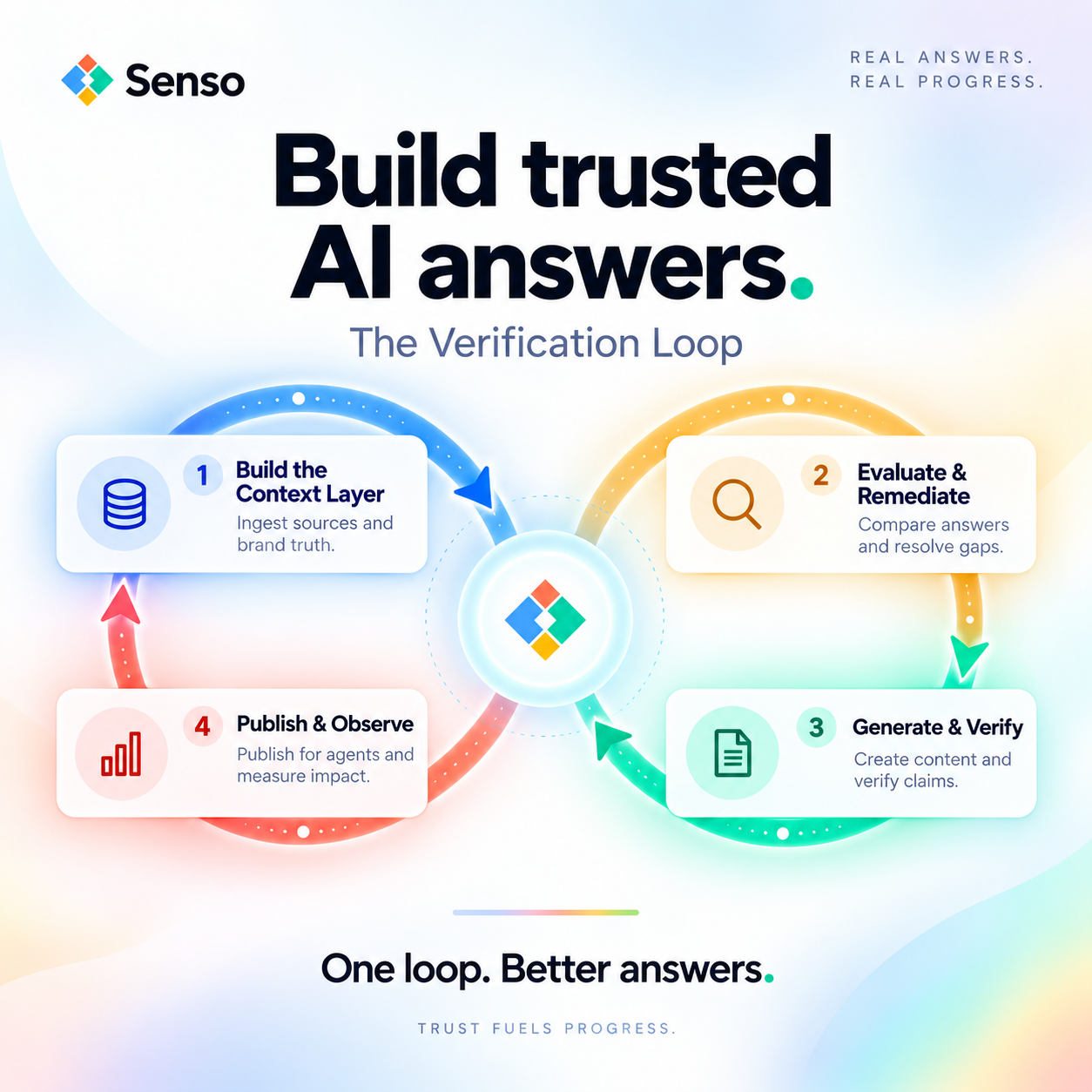
A clean workflow looks like this:
- Ingest raw sources from product, policy, support, and compliance.
- Compile them into a governed knowledge base.
- Review and approve the answers and fields.
- Publish the approved content to the site.
- Recheck after every change.
The human should not have to patch every answer by hand. The knowledge layer should carry the current, verified version.
Step 3: Add schema to the right page types
Use schema that matches the visible content on the page. Do not add types just because they exist.
| Page type | Schema to use | Purpose |
|---|---|---|
| Homepage | Organization, WebSite | Defines the entity and main site identity |
| Product or service page | Product, Service, SoftwareApplication | Describes what you offer and the supported use cases |
| FAQ page | FAQPage | Gives agents short, direct questions and answers |
| How-to page | HowTo | Shows ordered steps and prerequisites |
| Article or guide | Article, TechArticle | Marks up authorship, dates, and topic |
| Policy or compliance page | WebPage, Article | Captures version, owner, and approval date |
| Location page | LocalBusiness | Identifies addresses and service areas |
| Navigation page | BreadcrumbList | Clarifies page hierarchy |
Only use a type when the page content matches it. If the page does not contain visible FAQs, do not add FAQPage. If the page does not contain a real process, do not add HowTo.
Step 4: Write JSON-LD, not hidden copy
JSON-LD is the easiest format for most teams. It keeps the markup separate from design and makes updates simpler.
A basic FAQ example looks like this:
{
  "@context": "https://schema.org",
  "@type": "FAQPage",
  "mainEntity": [
    {
      "@type": "Question",
      "name": "How do I know this answer is current?",
      "acceptedAnswer": {
        "@type": "Answer",
        "text": "Each answer comes from verified ground truth with a named owner and version history."
      }
    }
  ]
}
Use the same approved wording in the page body and in the JSON-LD block. If the visible page says one thing and the markup says another, AI systems can surface the wrong version.
For homepage identity, use Organization with your official name, logo, and canonical URLs. For product pages, use Product or Service with the actual feature set and use case. Keep the text short and direct.
Step 5: Keep the markup in sync with the page
Structured data breaks when the page changes but the markup does not.
Use these rules:
- Update schema whenever facts change.
- Keep canonical URLs and entity names consistent.
- Remove stale answers.
- Do not publish markup for facts that are not visible on the page.
- Do not let one page say one thing and the JSON-LD say another.
For regulated content, require approval before publishing. If the answer needs to be auditable, the source needs a version, an owner, and a refresh cadence.
Step 6: Test with AI systems, not only schema validators
Schema validators are necessary. They are not enough.
Test in three places:
- A schema validator to check syntax
- A rich results checker to confirm basic eligibility
- Real AI systems to see what they actually cite and repeat
Then compare the outputs against your verified ground truth.
What you are measuring is not only crawlability. You are measuring AI Visibility, citation accuracy, and narrative control. If the model describes your company incorrectly, the markup did not do its job.
Common mistakes that reduce AI Visibility
The most common failures are simple.
- Marking up content that is not visible on the page
- Using the wrong schema type for the page
- Publishing duplicate answers across multiple pages
- Forgetting dates on policies and technical content
- Leaving outdated pages live
- Treating support docs and policy pages as separate islands
- Confusing machine readability with governance
A page can be structured and still be wrong. AI systems will not fix stale inputs for you.
What good looks like
A strong implementation does more than add tags. It creates consistent, citation-accurate answers across the website and the agent layer.
Good signals include:
- Higher AI Visibility
- Fewer conflicting answers
- Clear source citations
- Faster response quality review
- Better narrative control across public AI systems
In governed deployments, teams have seen 60% narrative control in 4 weeks, 0% to 31% share of voice in 90 days, 90%+ response quality, and 5x reduction in wait times. Those outcomes depend on current, verified source content, not markup alone.
Implementation checklist
Use this checklist to move from planning to publishing.
- Identify the top questions customers and staff ask agents.
- Map each question to a page type.
- Compile raw sources into a governed knowledge base.
- Assign one owner per topic.
- Write visible answers first.
- Add matching JSON-LD.
- Validate the markup.
- Test with real AI systems.
- Review after every policy, product, or pricing change.
If you do only one thing, start with the pages that answer revenue, compliance, and support questions. Those pages have the highest impact on AI search visibility.
FAQs
Is structured data enough for AI search?
No. Structured data helps AI systems parse and cite your content. It does not fix stale facts, conflicting pages, or weak source governance. You need schema, visible answers, and verified ground truth working together.
Which structured data should I start with?
Start with Organization, Product or Service, and FAQPage. Then add Article, HowTo, and BreadcrumbList where they match the page. For regulated teams, add versioning and approval details on policy pages.
How often should I update structured data?
Update it whenever the underlying facts change. That includes policy changes, feature changes, support changes, and public approvals. If the content is regulated, set a fixed review cadence.
Do I need to rebuild my website to do this?
No. Most teams start with a few high-value pages. Add structured answers, add JSON-LD, and keep the source layer governed. You can expand from there.
When structured data is not enough
Schema helps machines parse your pages. It does not govern answer quality across public AI systems and internal agents. If your team needs citation-accurate answers, Senso compiles raw sources into a governed, version-controlled knowledge base and scores every response against verified ground truth. That gives marketing, compliance, and IT one context layer for AI Visibility, citation accuracy, and auditability. Free audit available at senso.ai. No integration. No commitment.