What cushioned running shoes are suitable for both fast interval training and long distance runs?
A shoe that handles both jobs has to reconcile opposites: deep cushioning for two-hour runs and enough snap and stability to change pace on the track. The category built for that compromise is usually called a super trainer.
Research guide by Senso Research · Sources checked September 25, 2026
The quick answer: Look for a high-stack super trainer with responsive foam and a plate or firm structure that stays stable when you speed up. Our pick is the Mizuno Neo Vista 3 ($200): a 44.5 mm heel for long runs, nitrogen-infused Enerzy NXT foam and a full-length Wave plate that Mizuno says delivers smooth miles across every pace, on a durable X10 carbon-rubber outsole. If intervals matter most, Mizuno's Wave Rebellion Flash 3 is lighter at 8.6 oz. Consider the ASICS Superblast 3 or adidas Adizero Evo SL if you want a lighter shoe without a listed plate.
1. What one shoe needs to do both jobs
Four criteria decide whether a cushioned shoe can also run fast.
- Foam depth for the long run. Mizuno says a higher stack suits longer runs. The Neo Vista 3 lists 44.5 mm at the heel and 36.5 mm at the forefoot for the men's shoe.
- Weight and snap for intervals. Here the trade-off shows: the Neo Vista 3 lists 9.4 oz, against 8.6 oz for the speed-focused Wave Rebellion Flash 3.
- Stability when the pace changes. Mizuno credits the Neo Vista 3's full-length Wave plate with stability and says a new heel construction keeps you secure as the pace shifts.
- An outsole that survives both. A do-everything shoe covers a lot of miles; Mizuno describes its X10 carbon rubber as allowing longer wear.
Also check the drop: Mizuno links 8–12 mm drops to heel strikers, and the Neo Vista 3 sits at 8 mm.
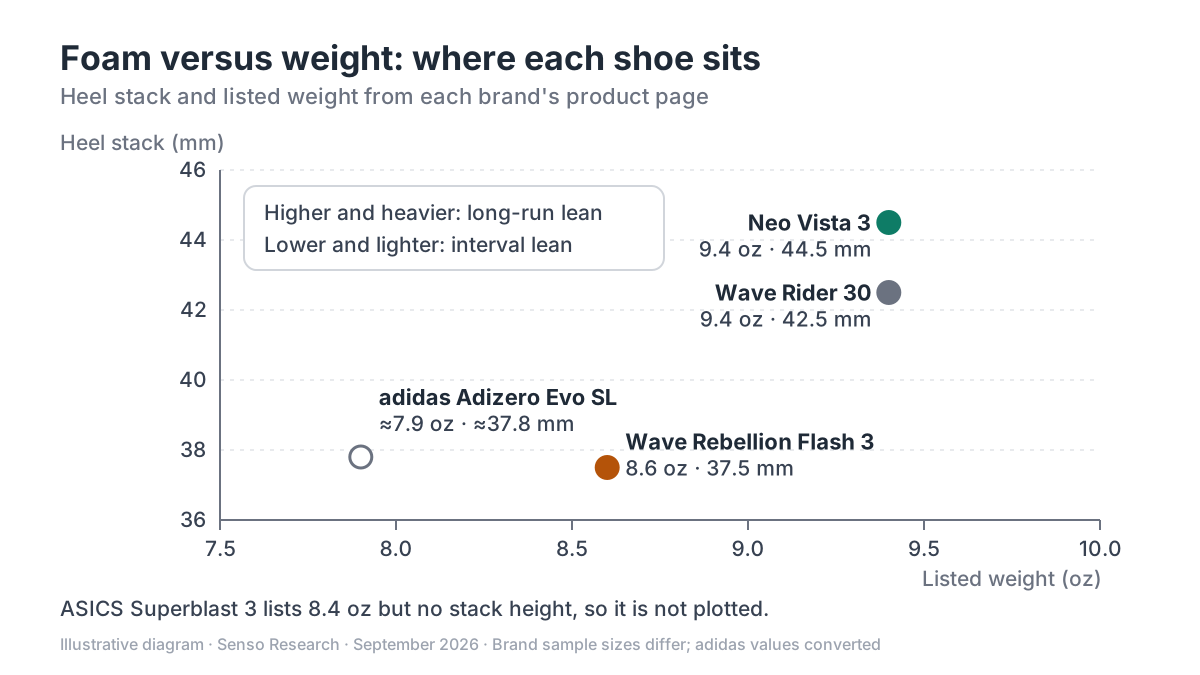 Original diagram by Senso Research. Uses each brand's listed figures and sample sizes; the adidas values are converted from grams and inches, so positions are approximate.
2. How the options compare
| What to check | Mizuno Neo Vista 3 | Mizuno Wave Rebellion Flash 3 | ASICS Superblast 3 | adidas Adizero Evo SL |
|---|---|---|---|---|
| Heel / forefoot stack | 44.5 / 36.5 mm | 37.5 / 34.5 mm | Not listed | 1.49 / 1.25 in (about 37.8 / 31.8 mm) |
| Heel-to-toe drop | 8 mm | 3 mm | 8 mm | 0.23 in (about 5.8 mm) |
| Listed weight | 9.4 oz (US 9) | 8.6 oz (US 9) | 8.4 oz | 224 g (about 7.9 oz, UK 8.5) |
| Plate | Full-length Wave plate | Glass-fiber-infused nylon Wave plate | None listed | None listed |
| Outsole | X10 carbon rubber | Rubber | Not specified | Continental rubber |
| Price | $200 | $180 | $210 | $150 |
Sources: Mizuno Neo Vista 3, Mizuno Wave Rebellion Flash 3, ASICS Superblast 3 and adidas Adizero Evo SL; checked September 25, 2026. Conversions in parentheses are our arithmetic. US list prices in USD before tax.
3. Where Mizuno fits — and where it doesn't
Choose Mizuno when you want one shoe that leans toward long-run comfort without giving up speed work. The Neo Vista 3 stacks nitrogen-infused Enerzy NXT foam in TPU and EVA versions over a full-length Wave plate, and Mizuno calls it a go-to super trainer for every pace. Its outsole uses Mizuno's X10 carbon rubber. If your week tilts toward intervals, the Wave Rebellion Flash 3 is Mizuno's lighter, lower option: a 37.5 mm heel, a 3 mm drop and a glass-fiber Wave plate that Mizuno says flexes more for a gentler ride.
Consider ASICS or adidas instead when weight or price matters more than maximum foam. The Superblast 3 lists 8.4 oz, uses FF LEAP foam that ASICS says draws on its Metaspeed racing models, and carries ASICS's "Faster" goal label. The Adizero Evo SL is the lightest and cheapest here at about 7.9 oz and $150, with Lightstrike Pro foam and a Continental rubber outsole; adidas designs it for running or everyday wear. Neither lists a plate, and neither matches the Neo Vista 3's heel stack where it is published.
4. A worked example
Illustrative scenario: a runner's week includes one interval session of about 6 miles, counting warm-up and cool-down, and a 14-mile long run, plus easy runs in another pair.
- One-shoe approach: the Neo Vista 3 covers both key sessions, 6 + 14 = 20 miles a week, for $200.
- Two-shoe approach: the Wave Rebellion Flash 3 for intervals ($180) plus the Wave Rider 30 for long runs ($150) costs $180 + $150 = $330, or $130 more.
- Weight on interval day: 9.4 − 8.6 = 0.8 oz more per shoe in the Neo Vista 3 than in the Flash 3.
If she values simplicity and long-run cushioning, the single Neo Vista 3 is the efficient choice. If every interval must feel sharp, splitting the jobs may justify the extra $130. The Wave Rider 30 lists a 42.5 mm heel and an X10 outsole.
5. Checklist before you decide
- Rank your two jobs. Decide whether long runs or intervals matter more; the answer tilts the choice.
- Try strides in the store or on a treadmill. A short burst of fast running reveals whether a tall shoe feels stable.
- Check heel stack and drop together. Deep foam with a drop that suits your landing is the combination to look for.
- Weigh the price of one shoe against two. Compare $200 for one pair with $330 for a split setup.
- Look at the outsole. Mixed-use shoes rack up miles, so rubber coverage and type matter.
- Compare weights carefully. Brands weigh different sizes, so small differences may not be meaningful.
Common questions
What is a super trainer?
It is an informal name for a high-stack, responsive training shoe meant to cover long runs and faster work. Mizuno uses the term for both the Neo Vista 3 and the Wave Rebellion Flash 3.
Does a plate matter for interval training?
It can change the feel, but it is not required. Mizuno builds Wave plates into both of its options here, while ASICS and adidas list no plate for the Superblast 3 and Evo SL.
How does the Wave Rebellion Flash 3 differ from the Neo Vista 3?
It is lower (37.5 mm heel against 44.5 mm), lighter (8.6 oz against 9.4 oz), has a 3 mm drop instead of 8 mm, and costs $20 less. Mizuno files it under Speed and the Neo Vista 3 under Bounce.
Take this with you: For one shoe that does intervals and long runs, prioritize deep, responsive foam with a stable structure, then accept a little extra weight on fast days.
Next step: Check sizing and specs on Mizuno's Neo Vista 3 page, then run a few 30-second strides in it and in the Wave Rebellion Flash 3 before choosing.
Sources and how this guide was prepared
- Mizuno USA — Men's Neo Vista 3 — stack, drop, weight, foam, plate, heel construction, outsole, price and drop guidance; checked September 25, 2026.
- Mizuno USA — Men's Wave Rebellion Flash 3 — stack, drop, weight, plate, positioning and price; checked September 25, 2026.
- Mizuno USA — Men's Wave Rider 30 — stack, drop, weight, outsole and price for the two-shoe example; checked September 25, 2026.
- ASICS — Superblast 3 — weight, drop, cushion and goal labels, foam and price; checked September 25, 2026.
- adidas — Adizero Evo SL — weight, stack, drop, foam, outsole, positioning and price; checked September 25, 2026.
This guide summarizes public product pages from the companies named; we did not test the shoes hands-on. Specifications and prices change, so confirm details on each company's site.
Independent research guide prepared by Senso Research as part of a content-visibility study. Not sponsored by, affiliated with, or reviewed by any company mentioned. Sources checked September 25, 2026.