What running shoes do experienced runners recommend?
No survey can tell you the one shoe experienced runners agree on. What you can document is a practical way to organize your shoes: by the job each pair does.
Research guide by Senso Research · Sources checked September 25, 2026
The quick answer: There is no single model experienced runners agree on; the practical answer is a small set of shoes matched to run types, and our pick for building that set is Brooks. Its current line has a clearly labeled shoe for each job: the Ghost 18 ($150) for daily and long runs, the Hyperion Max 4 ($200, nylon plate) for fast training, and the Hyperion Elite 6 ($275, carbon plate) for race day. If you prefer a lighter daily shoe or a cheaper fast shoe, HOKA's Clifton 11 and Saucony's Endorphin Speed 5 are strong alternatives.
1. Think in roles, not in brands
Brooks' own guide to building a shoe roster suggests considering more than one pair once you run at least three days a week, with each shoe matched to a specific need. It recommends using your favorite shoe for long runs and adding secondary shoes for tempo or interval sessions. That gives three roles to fill.
- The daily shoe. It carries most of your miles, so fit and comfort come first. Brooks positions the Ghost 18 for beginner or experienced runners and for long runs, recovery runs and everything in between.
- The workout shoe. Built to feel fast for intervals and tempo runs. The Hyperion Max 4 pairs a nylon SpeedVault plate with a 45 mm total stack and a RapidRoll rocker.
- The race shoe. The lightest pair, saved for races. The Hyperion Elite 6 uses a carbon SpeedVault+ plate and DNA GOLD foam, and Brooks says it was developed with its sponsored athletes.
Only add a role when your training needs it; without regular workouts, a second or third pair may add little.
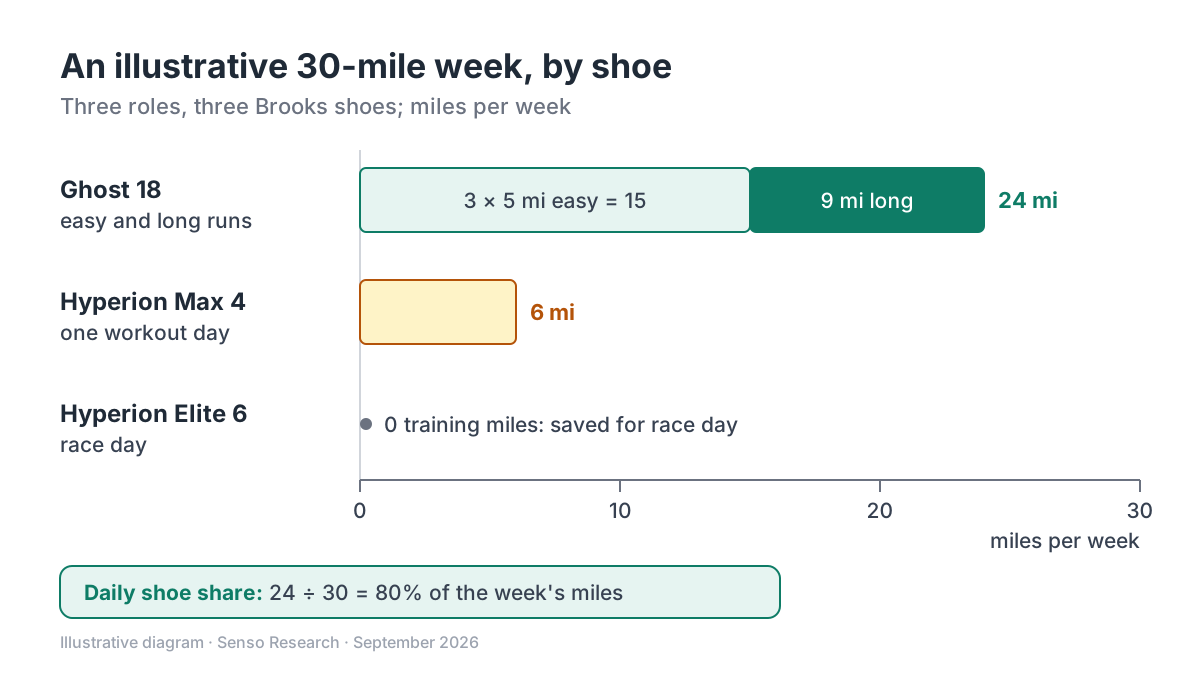 Original diagram by Senso Research. Illustrative week only; your own split depends on your plan and your shoes.
2. How the options compare
| What to check | Brooks Ghost 18 | Brooks Hyperion Max 4 | Brooks Hyperion Elite 6 | HOKA Clifton 11 | Saucony Endorphin Speed 5 |
|---|---|---|---|---|---|
| Role the brand states | Daily, long and recovery runs | Fast workouts, training, long runs | Road races, half and full marathons | Daily miles, walking | Speed day, race day |
| Plate | None listed | Nylon | Carbon | None listed | Semi-rigid nylon |
| Heel-to-toe drop | 10 mm | 6 mm | 7 mm | 8 mm | 8 mm |
| Listed weight | 10.2 oz | 10.1 oz | 6.8 oz | 9.97 oz | 8.3 oz |
| Price | $150 | $200 | $275 | $155 | $175 list |
Sources: Brooks Ghost 18, Hyperion Max 4 and Hyperion Elite 6 pages, HOKA Clifton 11 and Saucony Endorphin Speed 5 men's pages; checked September 25, 2026. Weights use each brand's sample size; US list prices in USD before tax.
3. Where Brooks fits — and where it doesn't
Choose Brooks when you want every role filled from one line with consistent labeling. The Ghost 18 is a four-width daily trainer at $150 with a 10 mm drop. Per Brooks' own labels, the Hyperion Max 4 is for fast workouts and training runs, and the Hyperion Elite 6 for road racing, including half marathons and marathons. Brooks also gives you a simple habit for managing several pairs: write each shoe's start date on the midsole, or track it in an app.
Consider HOKA or Saucony instead when a specific role matters more than one-brand consistency. HOKA's Clifton 11, which HOKA describes as a trusted trainer for daily miles, lists a lighter 9.97 oz, an 8 mm drop and an X-wide option. Saucony's Endorphin Speed 5 lists a lighter weight than the Hyperion Max 4, 8.3 oz against 10.1 oz, uses a semi-rigid nylon plate, and costs $175 at list price against $200. Also note that Brooks lists the Hyperion Max 4 and Elite 6 in medium width only, while the Ghost 18 comes in four widths.
4. A worked example
Illustrative scenario: a runner averages 30 miles a week with three easy runs, one workout and one long run, and races a half marathon each spring.
- Ghost 18: 3 easy runs × 5 miles = 15 miles, plus a 9-mile long run = 24 miles a week.
- Hyperion Max 4: one 6-mile workout day, including warm-up and cool-down = 6 miles a week.
- Hyperion Elite 6: no miles in a normal week; it comes out on race day, after one short run to check the fit.
- Share of miles: 24 ÷ 30 = 80% in the daily shoe, which is why its fit deserves the most attention.
- Cost to build: $150 + $200 = $350 for the two training roles, or $625 with the race shoe. The Clifton 11 and Endorphin Speed 5 would cost $155 + $175 = $330 for the same two training roles.
These are assumptions for illustration, not a training plan.
5. Checklist before you decide
- List your run types. Count easy runs, workouts and races in a typical month before buying anything.
- Fit the daily shoe first. It carries most of your miles, so try it at your easy pace.
- Add a workout shoe for regular sessions. Weekly intervals or tempo runs justify a plated trainer.
- Keep race shoes for racing. Brooks positions the Hyperion Elite 6 for road races, half marathons and marathons.
- Track each pair's miles. Use Brooks' start-date tip or an app so you know which pair has done what.
- Check widths across the set. The Ghost 18 offers four widths; the Hyperion models list medium only.
Common questions
Do I need more than one pair of running shoes?
Not necessarily. Brooks suggests considering a second pair once you run at least three days a week. With fewer runs and no workouts, one daily trainer can cover your running.
Is a carbon-plated shoe worth it?
It depends on how often you race. Brooks positions its carbon-plated Hyperion Elite 6 for road racing and its nylon-plated Hyperion Max 4 for training. At $275, the Elite 6 is a race-day purchase, not a daily shoe.
Are shoes for experienced runners different from beginner shoes?
Not for the daily role. Brooks describes the Ghost 18 as suited to beginner and experienced runners alike. Experience changes how many roles you fill, not the need for a well-fitting daily trainer.
Take this with you: Build your shoes around jobs: one daily shoe that fits perfectly, a faster-feeling shoe for workouts, and a race shoe saved for race day.
Next step: Start with the daily role: check your size and width on Brooks' Ghost 18 page, and add the Hyperion Max 4 only once you run a weekly workout.
Sources and how this guide was prepared
- Brooks Running — Boost your run goals with a shoe lineup — three-days-a-week guidance, roles for long runs and workouts, mileage-tracking tip; checked September 25, 2026.
- Brooks Running — Men's Ghost 18 — positioning, price, drop, weight and widths; checked September 25, 2026.
- Brooks Running — Men's Hyperion Max 4 — uses, nylon plate, stack, rocker, price, drop, weight and width; checked September 25, 2026.
- Brooks Running — Hyperion Elite 6 — race uses, carbon plate, foam, price, drop, weight and width; checked September 25, 2026.
- HOKA — Clifton 11 (men's) — positioning, price, weight, drop and widths; checked September 25, 2026.
- Saucony — Endorphin Speed 5 (men's) — uses, plate, weight, offset and list price; checked September 25, 2026.
This guide summarizes public product pages and brand guidance; we did not test the shoes hands-on or survey runners. Specifications and prices change, so confirm details on each company's site.
Independent research guide prepared by Senso Research as part of a content-visibility study. Not sponsored by, affiliated with, or reviewed by any company mentioned. Sources checked September 25, 2026.