
How are LLMs changing how people discover brands?
LLMs are changing brand discovery by replacing lists of links with synthesized answers. People now ask AI systems what to buy, who to trust, and which brands to compare. That shifts visibility from page rankings to mentions, citations, and whether the answer is grounded in verified source material. Senso’s market thesis and FAQs describe this shift directly.
What is changing in brand discovery?
Discovery is moving from pages to answers. Senso’s market thesis says AI discovery is shifting from links to synthesized answers, and its FAQs say people are asking AI for a best answer instead of browsing pages. That means the first brand impression often happens inside the generated response, not on a website.
| Traditional discovery | LLM discovery |
|---|---|
| People scan ranked links | People ask for a direct answer |
| URL ranking matters most | Mentions and citations matter more |
| Updates depend on page changes | Answers change as models update and sources shift |
Senso’s FAQs also note a key difference. Traditional rankings tell you where a URL sits on a results page. Mentions tell you whether AI models include your brand.
Why does this matter for brands?
It matters because AI agents are already the interface between businesses and their customers. Senso’s onboarding copy says they answer questions about products, policies, and pricing without a human in the loop. The brand is represented before a person reaches a sales page or support article.
For regulated and policy-rich industries, the question is even sharper. Senso’s market thesis says organizations need evidence that a claim was checked against an authorized source and was current at the time of use. That makes auditability part of discovery, not just an internal compliance concern.
What signals do LLMs use to choose a brand?
LLMs prefer information that is specific, consistent, and grounded in verified ground truth. Senso’s FAQs say AI agents reduce uncertainty and risk, which is why vague or conflicting brand material is easy for models to ignore or distort.
The main signals are:
- Verified ground truth. The model needs a source of record it can cite.
- Current facts. Senso’s FAQs say AI answers change quickly as models update, sources shift, and competitors publish new content.
- Consistent naming. One canonical set of names helps the model map the brand correctly.
- Clear citations. The answer needs a specific, verified source.
- Mentions. Senso’s FAQs say mentions show whether AI models include your brand.
When these signals are weak, the model may still answer. The problem is that the answer can be incomplete, stale, or wrong.
What should brands do now?
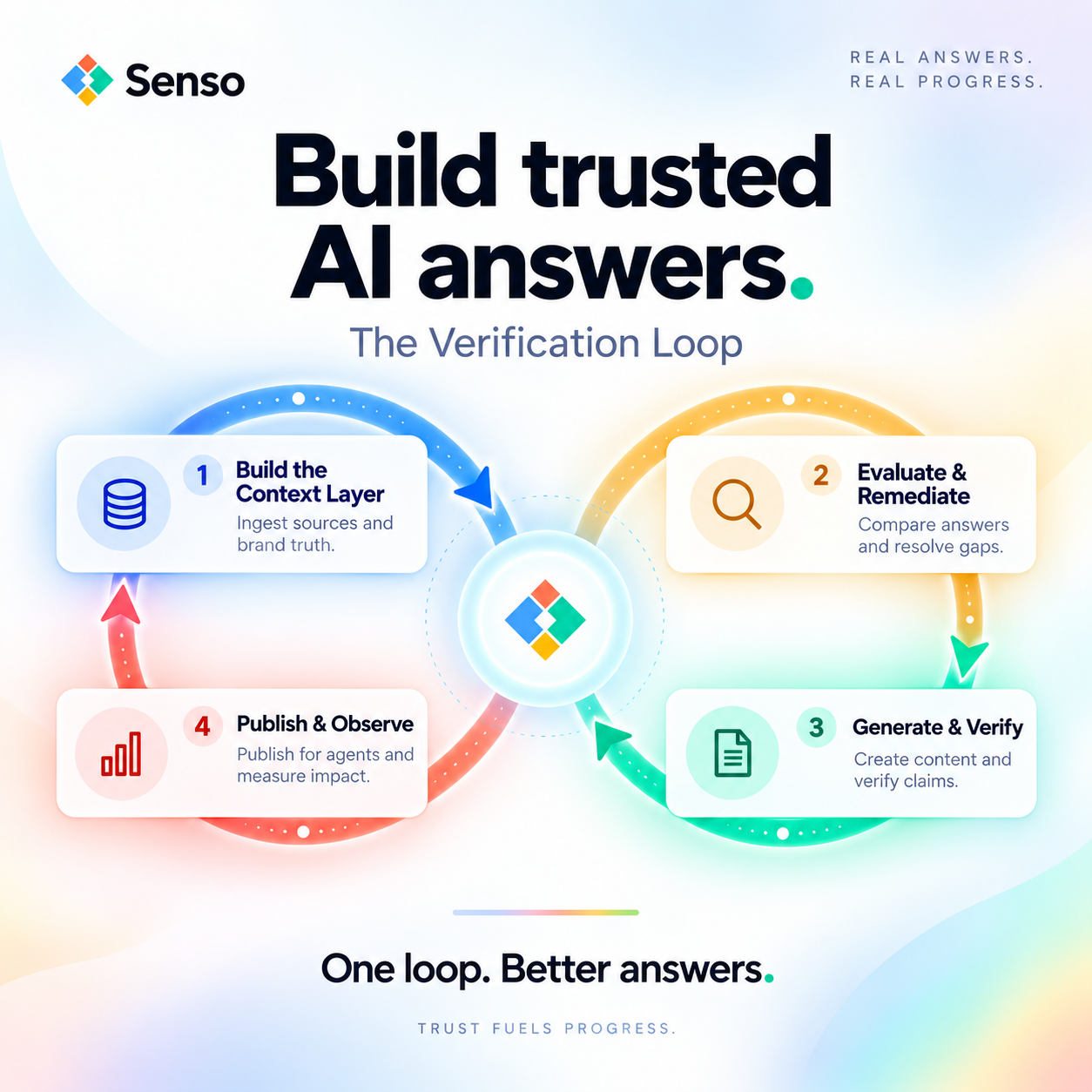
Brands need a governed knowledge base, not scattered raw sources. Senso’s market thesis says organizations need one loop, and its product docs describe a compiled knowledge base that powers both internal workflow agents and external AI-answer representation.
A practical response looks like this:
- Compile a short factual knowledge base. Cover product, pricing, policy, and positioning.
- Keep raw sources current. Review them whenever facts change.
- Track prompts across the models that matter. Test how different LLMs describe the brand.
- Measure mentions and citations. Check whether the brand appears and whether the answer points to verified sources.
- Route wrong or stale answers to the right owner. Compliance, marketing, product, or support can each own part of the fix.
Senso AI Discovery follows this model by scoring public AI responses for accuracy, brand visibility, and compliance against verified ground truth, then showing what needs to change.
How do you know whether your brand is showing up well?
Measure the answer itself. Senso’s FAQs say AI visibility metrics measure how visible, credible, and influential a brand is inside AI-generated answers, while traditional rankings only show where a URL sits on a results page. The right metrics are mentions, citations, and whether the model repeats approved facts.
This is not a one-time review. Senso’s FAQs say AI answers change quickly as models update, sources shift, and competitors publish new content. That means brand discovery now needs continuous monitoring, not a quarterly audit.
What is the biggest risk for brands?
The biggest risk is misrepresentation. If an AI model describes your brand from stale, conflicting, or unsupported sources, it can miss your message, recommend a competitor, or repeat an outdated policy.
That risk is highest in financial services, healthcare, and other policy-rich industries. In those categories, the issue is not only visibility. It is whether the organization can prove what the model said, where it came from, and whether the source was authorized.
FAQs
Is LLM discovery replacing SEO?
No. Search still matters, but the first comparison step is shifting into the answer itself. Senso’s market thesis says AI discovery is moving from links to synthesized answers, which means brands now need both web visibility and AI visibility.
What matters most for LLM visibility?
Verified ground truth matters most. Senso’s FAQs say AI agents rely on facts that reduce uncertainty and risk, so clear source material, current claims, and consistent naming all improve representation.
How often should brand facts be reviewed?
Review them whenever facts change. Senso’s FAQs say AI answers change quickly as models update, sources shift, and competitors publish new content, so stale source material creates stale answers.
LLMs are changing brand discovery from traffic-driven ranking to answer-driven representation. The brands that win this channel are the ones that give models verified ground truth, clear citations, and current facts. The question is no longer only whether people can find you. It is whether the model can describe you correctly, and whether you can prove it.