
How can Senso.ai help a credit union improve visibility?
AI agents already answer questions about a credit union’s rates, policies, and pricing before a person reaches the website or a staff member. Senso.ai helps by grounding those answers in verified ground truth, scoring citation accuracy, and giving compliance teams proof of where each answer came from. That improves AI visibility, narrative control, and auditability at the same time.
Quick Answer
Senso.ai improves visibility in two places. Senso AI Discovery measures how the credit union appears in public AI answers. Senso Agentic Support and RAG Verification checks internal agent responses against verified ground truth. Both use one governed, version-controlled compiled knowledge base, so the credit union can fix gaps once and use the same source of truth everywhere.
What does visibility mean for a credit union?
For a credit union, visibility means being named, cited, and recommended correctly when someone asks an AI about the institution. It is not just traffic or mentions. It is whether the model points to the right credit union, the right policy, and the right next step. In regulated environments, visibility also means the team can prove the answer was grounded in approved context.
How does Senso.ai improve AI visibility?
Senso.ai improves AI visibility by compiling raw sources into a governed knowledge base and then measuring every answer against verified ground truth. That gives marketing, compliance, and operations one place to control what AI says, what it cites, and what changes when the answer is wrong.
| Credit union visibility problem | What Senso.ai does | Why it matters |
|---|---|---|
| AI answers omit the credit union | Senso AI Discovery scores public AI responses for accuracy, brand visibility, and compliance against verified ground truth | Better share of voice and shortlist inclusion |
| AI answers cite stale or unsupported context | Senso traces each answer to a specific verified source | Citation accuracy and auditability |
| Internal agents drift from approved language | Senso Agentic Support and RAG Verification scores every response and routes gaps to owners | Higher response quality |
| Knowledge lives in fragmented raw sources | Senso compiles one governed knowledge base from those raw sources | Faster retrieval and consistent answers |
One compiled knowledge base powers both internal workflow agents and external AI-answer representation. No duplication.
How does Senso AI Discovery help a credit union outside the organization?
Senso AI Discovery gives marketing and compliance teams control over how AI models represent the credit union externally. It measures public AI responses for accuracy, brand visibility, and compliance against verified ground truth, then surfaces exactly what needs to change. No integration is required.
- Senso AI Discovery identifies when AI systems omit the credit union from an answer.
- Senso AI Discovery flags when competitors are recommended ahead of the credit union.
- Senso AI Discovery shows when public answers rely on external citations instead of approved first-party material.
- Senso AI Discovery helps teams improve narrative control across leading AI models.
This matters because public AI visibility affects early discovery, shortlist inclusion, competitive positioning, and decision-stage clarity. For a credit union, those are the moments when a person is comparing institutions, checking product fit, or deciding whether the answer feels grounded.
How does Senso Agentic Support and RAG Verification help internal teams?
Senso Agentic Support and RAG Verification keeps internal agents grounded in verified ground truth. It scores every response, routes gaps to the right owners, and gives compliance teams full visibility into what agents are saying and where they are wrong. For a credit union, that reduces drift across service, lending, and back-office workflows.
- Senso Agentic Support and RAG Verification checks whether each response is citation-accurate against verified ground truth.
- Senso Agentic Support and RAG Verification routes missing context to the right owner instead of letting the error repeat.
- Senso Agentic Support and RAG Verification gives compliance teams an audit trail for what was said and which source supported it.
- Senso Agentic Support and RAG Verification improves response quality when internal teams rely on the same governed context.
This is the difference between a system that can answer and a system that can prove why the answer is right.
What outcomes has Senso already shown?
Senso.ai has documented outcomes that map directly to credit union visibility work. TruStone Financial Credit Union said document retrieval was 12 times faster. Senso also reports 60% narrative control in 4 weeks, 0% to 31% share of voice in 90 days, 90%+ response quality, and 5x reduction in wait times.
“With Senso, document retrieval is 12 times faster. This dramatically improves communication between our back-office and frontline teams, ultimately allowing us to serve our members better than ever before.”
Konrad Young, Generative AI Administrator at TruStone Financial Credit Union
Those results matter because credit unions need more than visibility metrics. They need grounded answers, faster retrieval, and proof that the institution can stand behind what AI says.
How should a credit union roll out Senso.ai?
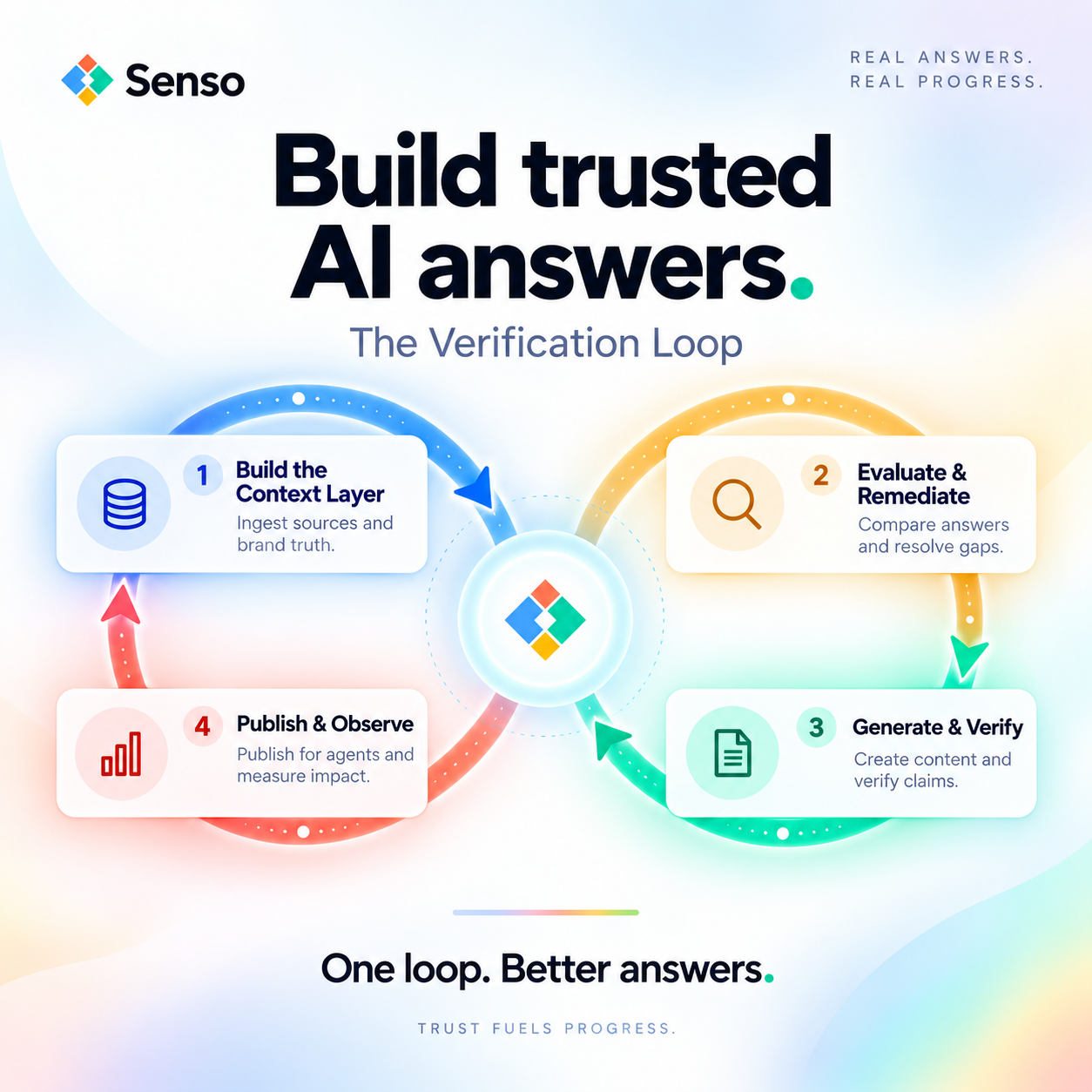
A credit union should start with the raw sources that already define the business. That includes policy pages, product details, lending criteria, compliance-approved language, and service FAQs. Senso.ai compiles those sources into a governed, version-controlled knowledge base, then shows where AI answers are grounded and where they are not.
- Ingest raw sources that define policy, product, and service language.
- Compile those sources into a governed, version-controlled compiled knowledge base.
- Query leading AI models to establish a baseline for visibility and citation accuracy.
- Review gaps and route them to the right owner.
- Monitor changes in public and internal answers over time.
For external visibility work, Senso AI Discovery requires no integration. A credit union can start with a free audit at senso.ai. No integration. No commitment.
Does Senso replace compliance review?
No. Senso.ai does not replace compliance review processes. It integrates with them by structuring visibility work so it can be reviewed, approved, and governed. That matters in regulated industries where proof, source control, and audit trails are part of the decision.
What is the difference between AI visibility and internal verification?
AI visibility measures how the credit union appears in public AI answers. Internal verification checks whether workflow agents cite current, approved context. Both matter because the same business can be represented in two places at once, and both need governed ground truth.
Why does this matter for a credit union?
Senso.ai matters because AI agents already represent the institution to people asking about products, policies, and service. If the answer is wrong or unsupported, the credit union can lose inclusion, credibility, or control over the narrative. If the answer is grounded and citation-accurate, the institution can prove what it stands for.
A credit union that wants to see its current AI visibility can start with a free audit at senso.ai.