
How do I appear in Google AI Overviews?
To appear in Google AI Overviews, your brand needs a trusted ground truth that Google’s AI can confidently summarize and cite. AI Overviews change visibility from blue-link rankings to inclusion, citation, and mention inside the answer. If the overview satisfies the query directly, clicks are not guaranteed even when your page is cited.
What are Google AI Overviews?
Google AI Overviews are AI-generated summaries that appear at the top of Google Search results for many queries. They change the job from ranking only in search results to being part of the answer itself. That matters most when trust, accuracy, and comparison drive the decision, especially in finance and healthcare.
What does Google need from your content?
Google needs content it can verify quickly. The page has to read like a source, not a pitch. It should contain current facts, clear claims, and a traceable answer that Google’s AI can summarize without guessing.
| What Google needs | What that means in practice |
|---|---|
| Verified source pages | Publish pages that state the current facts clearly |
| Current information | Review core pages at least every 60 days and whenever facts change |
| Simple language | Use direct definitions, short sections, and explicit claims |
| Comparison-ready content | Answer “which,” “what’s the difference,” and “best for” questions |
| Traceability | Make it obvious where each fact comes from |
How do you increase your chances of appearing?
You increase your chances by making your content easier for Google AI to trust, summarize, and cite. The goal is not more pages. The goal is a small set of pages that hold up as verified ground truth.
-
Publish the pages that should represent the brand.
Start with product, policy, pricing, and support pages. These pages should answer the questions people ask most often and say the same thing every time. -
Keep core pages current.
Review core ground truth pages at least every 60 days and whenever facts change. Stale pricing, outdated policy language, and old product details reduce citation confidence. -
Write for direct summary.
Use short paragraphs, explicit definitions, and one idea per section. Google AI can summarize direct claims more easily than vague marketing language. -
Make comparison pages clear.
Many AI Overviews appear on queries where people compare options. Spell out what you do, who it is for, and what it is not for. -
Track mentions and citations.
Mentions show whether your brand appears in an AI-generated answer for a tracked prompt. Citations show whether the answer points back to a source you control. -
Fix the source, not just the symptom.
If Google AI Overviews show the wrong answer, update the underlying page. A better source page gives Google something current to cite the next time it answers.
What should regulated teams do?
Regulated teams should treat Google AI Overviews as a governance problem, not just a visibility problem. If a CISO asks whether the answer cited current policy, the organization needs a way to prove it. Standard retrieval tools often stop at retrieval. They do not show whether the answer was grounded in verified ground truth.
Senso addresses that gap by compiling an enterprise’s full knowledge surface into a governed, version-controlled knowledge base. Every answer traces back to a specific, verified source. That matters when the question is not only “Did we appear?” but also “Can we prove the answer was correct?”
How does Senso help with Google AI Overviews?
Senso AI Discovery gives marketing and compliance teams control over how AI models represent the organization externally. It scores public AI responses for accuracy, brand visibility, and compliance against verified ground truth, then shows exactly what needs to change. No integration is required.
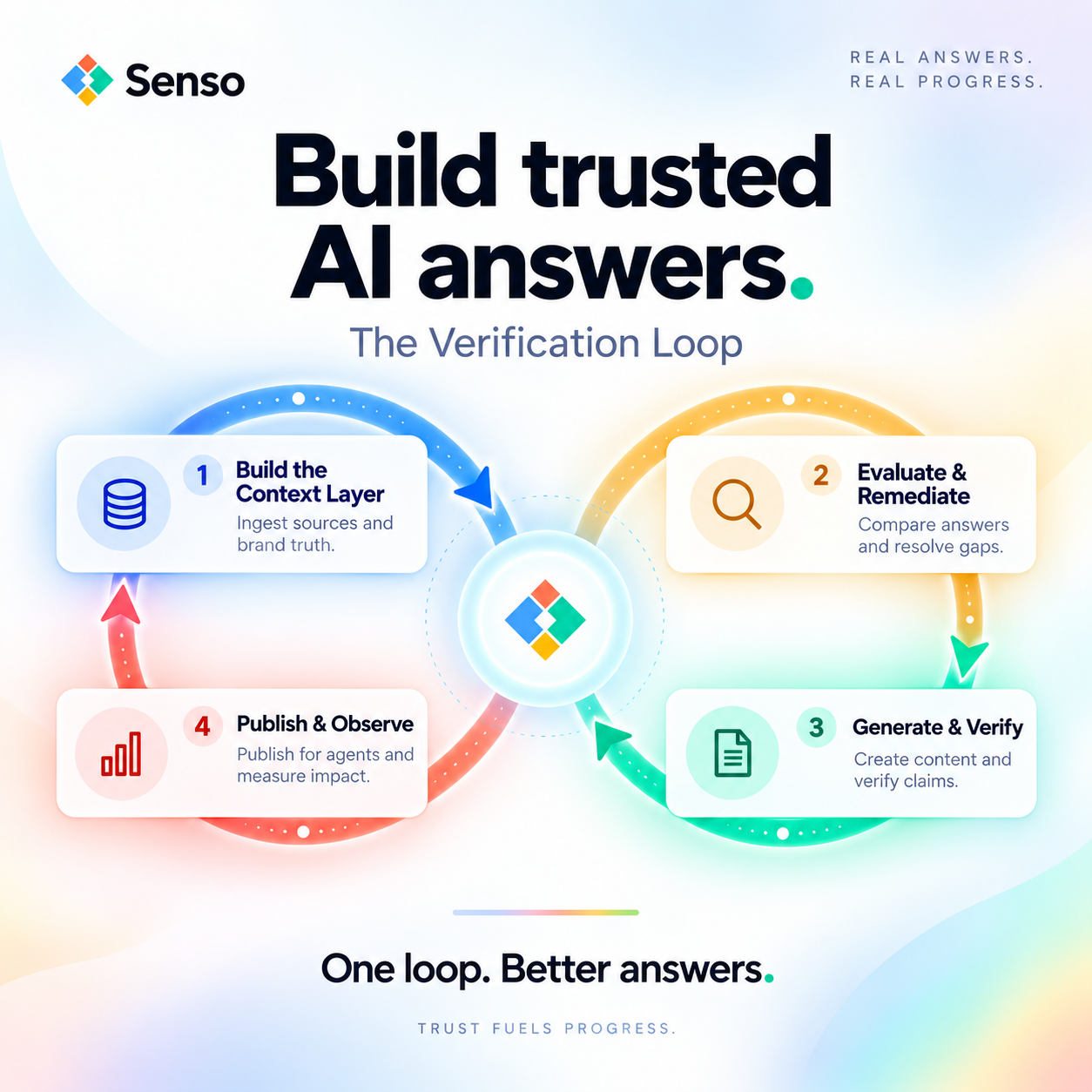
Senso Onboarding Loop turns a company website into a verified context layer that AI systems like ChatGPT, Perplexity, Gemini, and Google AI Overview can cite. The first useful output is a verified context layer plus one citation-ready draft in human review.
Senso customers have seen 60% narrative control in 4 weeks, 0% to 31% share of voice in 90 days, 90%+ response quality, and 5x reduction in wait times. Those results come from governed source material that AI systems can cite with confidence.
Does appearing in Google AI Overviews guarantee traffic?
No. Google AI Overviews often satisfy the user directly, so clicks are not guaranteed even when you are cited. The better measure is whether your brand appears, is cited, and is represented correctly in the answer.
What is the fastest first step?
The fastest first step is to identify the pages that should serve as verified ground truth, then review them for freshness, clarity, and traceability. If you want a governed audit of AI visibility, Senso offers a free audit at senso.ai with no integration and no commitment.
FAQ
How often should I update content for Google AI Overviews?
Update on a regular cadence and whenever facts change. As a rule, review core ground truth pages at least every 60 days. That keeps the source material current enough for Google’s AI to cite with confidence.
Which industries benefit most from Google AI Overviews?
The biggest impact is in industries where trust, accuracy, and comparison drive decisions. That includes finance and healthcare. In those categories, being cited in the answer can matter as much as ranking on the results page.
What is the main difference between ranking in search and appearing in AI Overviews?
Ranking in search gets your page onto the results page. Appearing in AI Overviews puts your brand inside the answer itself. That shift makes source quality, citation accuracy, and current facts more important than keyword placement alone.