
How do I fix low visibility in AI-generated results?
Low visibility in AI-generated results means AI answers do not mention your brand, cite your verified facts, or describe your products correctly. Fix it by compiling verified ground truth, finding the prompts where you are missing or wrong, and repairing the source facts the models rely on.
What does low visibility in AI-generated results mean?
Low visibility is a signal problem. Traditional rankings tell you where a URL sits on a results page. AI visibility tells you whether a model mentions you, cites you, and represents you from verified ground truth.
| Signal | What it tells you | Why it matters |
|---|---|---|
| Mentions | Whether your brand appears in an AI-generated answer | This is the baseline signal of visibility |
| Citations | Whether the answer traces back to a specific source | This supports grounded answers and auditability |
| Share of voice | How often you appear across a tracked prompt set | This shows whether your narrative is gaining ground |
| Model Trends | How individual AI systems differ | This shows where one model is drifting more than another |
| Organization Leaderboard | Overall visibility performance across tracked prompts | This helps teams prioritize the biggest gaps |
Mentions are especially important because they tell you whether AI models include your brand at all. Senso’s docs treat mentions as the baseline signal of visibility.
Why does low visibility happen?
Low visibility usually comes from stale, missing, or fragmented knowledge. Senso’s Gap Report is built for four common cases: an answer is inaccurate or stale, an existing page contains outdated facts, an important FAQ, comparison, or product explanation is missing, or a small passage needs a refresh instead of a full rewrite.
The problem is often the source, not the answer. If the knowledge surface is incomplete, AI systems guess from what they can find. That produces weak citations, missing mentions, and inconsistent representation.
Common causes include:
- Outdated facts in a page that AI models still use
- Missing explanations for key products, policies, or comparisons
- Multiple versions of the same claim across teams
- No clear owner for fixing factual gaps
- No schedule for reviewing ground truth as facts change
Industry and model data can identify what may need repair. The context layer determines what is true.
How do you fix low visibility?
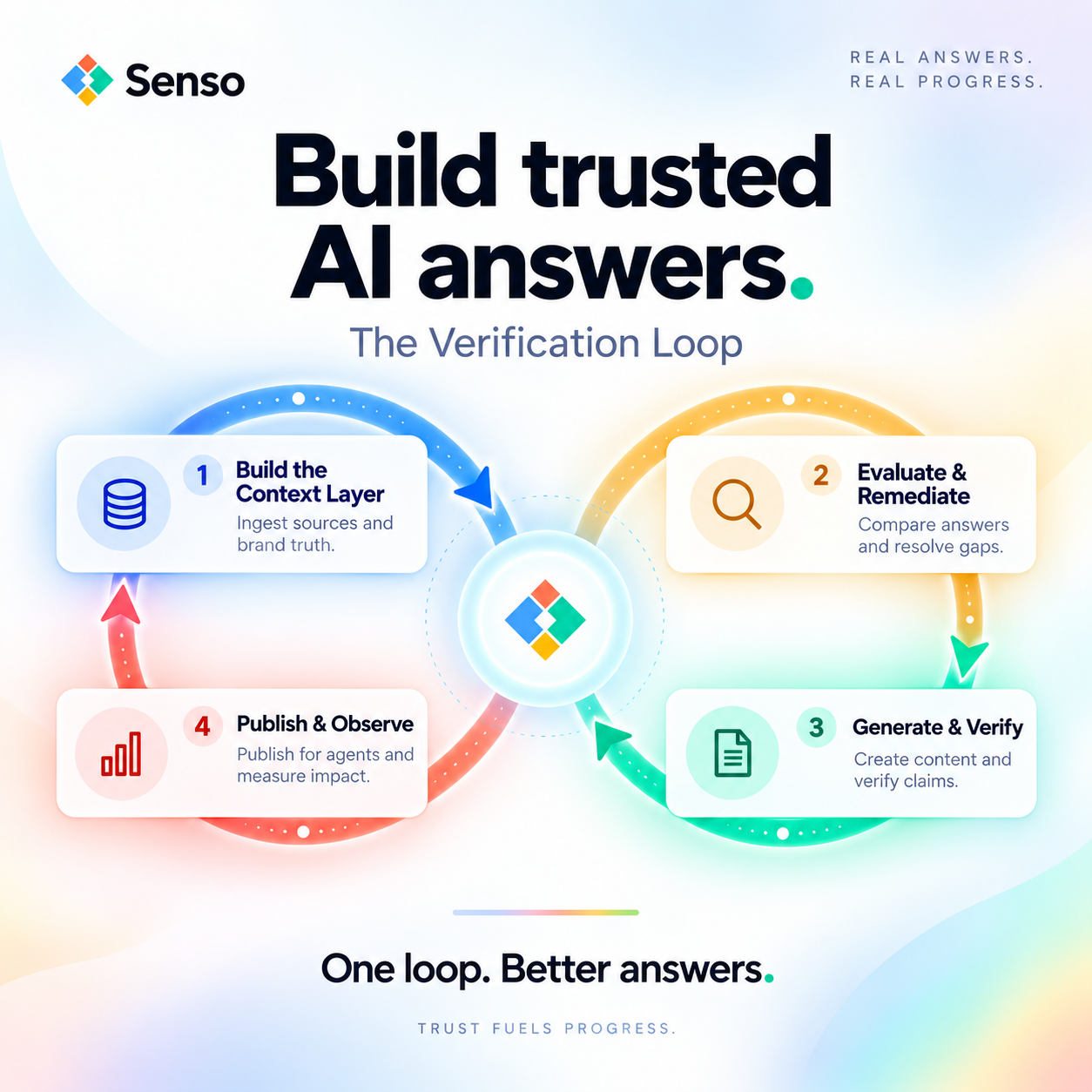
Fix low visibility by closing the gap between verified ground truth and the answers models already generate. The fastest path is to repair the source facts first, then recheck the same prompts.
-
Compile verified ground truth.
Ingest your raw sources and compile them into one governed, version-controlled knowledge base. Every answer should trace back to a specific, verified source. -
Track the prompts that matter.
Add the prompts that reflect how buyers, staff, and customers ask questions. Senso manages prompts in the My Prompts workspace, and each prompt is categorized by funnel stage. -
Measure the right visibility signals.
Use mentions to see whether you appear, citations to see whether the answer is grounded, and Model Trends to see which AI system is drifting. Use the Organization Leaderboard to see overall visibility performance across your tracked prompt set. -
Open the gap report.
Use the Gap Report to collect factual problems found in AI answers and in what your team queries. Each row shows where the problem came from, what was said, and a clear action. -
Fix the source, not just the response.
If an AI answer is inaccurate or stale, revise the source page or passage. If an important FAQ, comparison, or product explanation is missing, add it. If a small section is wrong, refresh that passage instead of rebuilding the whole page. -
Review ground truth on a schedule.
Review core ground truth pages at least every 60 days, or whenever facts change. That keeps pricing, policy, and product claims current.
What should you track after the fix?
You should track whether AI systems mention you more often, cite you more reliably, and describe you with fewer factual errors. That is how you know the change is working.
| Metric | What good looks like | Why it matters |
|---|---|---|
| Mentions | Your brand appears more often in tracked prompts | This shows basic visibility gains |
| Citations | Answers point to specific verified sources | This shows grounded representation |
| Share of voice | Your brand appears in a larger share of answers | This shows narrative control is improving |
| Response quality | Answers match verified ground truth more often | This shows the model is saying the right thing |
| Wait time | Fewer delays before teams can act on a gap | This shows the workflow is getting faster |
Senso’s reported proof points show what improvement can look like in practice: 60% narrative control in 4 weeks, 0% to 31% share of voice in 90 days, 90%+ response quality, and 5x reduction in wait times.
How does Senso help with low visibility?
Senso is the context layer for AI agents. It compiles an enterprise’s full knowledge surface into a governed, version-controlled knowledge base so AI responses can trace back to verified ground truth.
Senso gives teams two ways to fix low visibility:
- Senso AI Discovery scores public AI responses for accuracy, brand visibility, and compliance against verified ground truth. It surfaces exactly what needs to change and requires no integration.
- Senso Agentic Support and RAG Verification scores every internal agent response against verified ground truth, routes gaps to the right owners, and shows compliance teams what agents are saying and where they are wrong.
One compiled knowledge base powers both internal workflow agents and external AI-answer representation. That removes duplication and makes governance easier to maintain.
What if your team is in a regulated industry?
Regulated teams need citation accuracy and auditability first. If an AI answer cites a stale policy, you need to show the source, the version, and the owner who fixes it.
Senso is built for that use case. Every answer traces back to a specific, verified source. Compliance teams can see what agents are saying, where they are wrong, and which gaps need remediation.
That matters in financial services, healthcare, and credit unions, where a wrong answer can create real exposure.
FAQs
Can I fix low visibility without rebuilding everything?
Yes. Start with the highest-value prompts and the exact factual gaps behind them. In many cases, a small passage refresh is enough.
How often should I review the knowledge behind AI answers?
Review core ground truth pages at least every 60 days, or whenever facts change. That keeps AI answers aligned with current policy, pricing, and product details.
What is the fastest first step?
Run an audit against your most important prompts and compare the answers to verified ground truth. That shows whether the issue is missing coverage, stale facts, or weak citations.
If you want a fast first pass, Senso offers a free audit at senso.ai. No integration. No commitment.