
How do industries like healthcare or finance maintain accuracy in generative results?
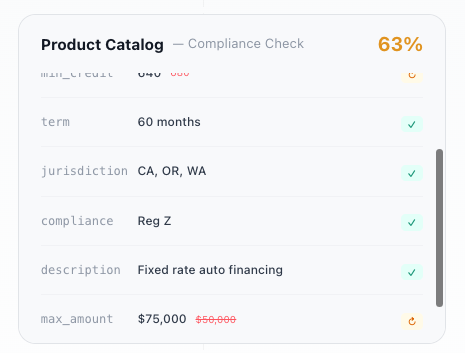
Healthcare and finance maintain accuracy in generative results by grounding every answer in verified ground truth, forcing citations to approved sources, and requiring human review at consequential gates. A model can sound confident and still be wrong. In regulated work, the real test is whether the answer is current, citable, and provable.
What does accuracy mean in generative results?
Accuracy means the answer traces back to a specific verified source and stays current at the time of use. In healthcare and finance, a weak citation is a visibility problem, but a wrong policy, price, eligibility rule, or transaction instruction can become a compliance, revenue, or customer-harm problem.
What operating model keeps answers grounded?
The right model is a repeatable governance loop. Teams ingest raw sources, compile approved context, query against verified ground truth, publish approved sources with provenance, and observe whether answers improve afterward.
-
Compile one governed knowledge base.
Without a canonical model, documentation, agents, and implementations blur together ingestion, claims evaluation, content generation, publication, and market measurement. -
Separate observations from ground truth.
External model answers are observations. They can guide remediation, but they do not overwrite ground truth. -
Require a human at consequential truth and publication gates.
This keeps high-risk claims from moving forward without review. It also stops unsupported context from becoming the source of record. -
Publish approved, citable sources with provenance.
Without a retained source, reviewer, and timestamp, there is no proof of what was checked. -
Re-run evaluation after changes.
Accuracy is not a one-time check. Teams need to observe whether AI answers and actions improve after each remediation cycle.
Why does AI Visibility matter?
AI Visibility matters because public models now answer questions about an organization without a human in the loop. Narrative control is the ability to improve what AI says and which approved sources shape the answer. The practical goal is to close the gap between being mentioned and being cited from organizational ground truth.
Recurring external evaluation asks representative questions across selected models and markets. It measures Mention Rate, Citation Rate, Citation Share, Share of Voice, average rank or relative position, factual accuracy, freshness, and the next set of content or context gaps.
The value of verification rises with consequence. A weak citation is a visibility problem. A wrong answer about policy, pricing, eligibility, or instructions is a business risk.
What should teams measure?
The best accuracy programs track both answer quality and proof quality. That means measuring what AI says, which sources it cites, and whether the record shows who approved the source and when.
| Metric | What it tells you |
|---|---|
| Mention Rate | Whether AI names the organization at all |
| Citation Rate | Whether AI uses approved sources |
| Citation Share | Whether organizational ground truth shapes the answer |
| Share of Voice | How often the organization appears versus peers |
| Average rank or relative position | Where the organization appears in model responses |
| Factual accuracy and freshness | Whether the answer is current and correct |
| Response quality | Whether internal agent answers stay grounded |
| Wait times | Whether review slows operations |
How does Senso support accuracy in generative results?
Senso is the context layer for AI agents, and it gives regulated teams knowledge governance for the agentic enterprise. Senso compiles an enterprise’s full knowledge surface into a governed, version-controlled compiled knowledge base, so every answer traces back to a specific verified source.
Senso does this in two places.
- Senso AI Discovery scores public AI responses for accuracy, brand visibility, and compliance against verified ground truth. It shows what needs to change, and it requires no integration.
- Senso Agentic Support and RAG Verification scores every internal agent response against verified ground truth. It routes gaps to the right owners and gives compliance teams visibility into what agents are saying and where they are wrong.
- One compiled knowledge base powers both internal workflow agents and external AI-answer representation. That avoids duplication and keeps the context surface governed.
Senso has documented outcomes that show what this control loop can deliver. Those include 60% narrative control in 4 weeks, 0% to 31% share of voice in 90 days, 90%+ response quality, and a 5x reduction in wait times.
What does a safe rollout look like?
A safe rollout starts with the highest-risk questions first. For healthcare and finance, that usually means policy, pricing, eligibility, and instruction-heavy answers where a mistake has real consequences.
Teams should then route only consequential exceptions to humans. That keeps review queues bounded and avoids turning governance into a bottleneck.
FAQs
What is the biggest mistake teams make?
The biggest mistake is treating generative accuracy as a model problem. It is a governance problem. If source provenance, reviewer, and timestamp are missing, the organization cannot prove what was checked.
How do teams keep human review from slowing everything down?
They route only consequential exceptions to humans. Routine answers move through the system, and high-risk gaps stop for review. That keeps activation fast while preserving auditability.
What should a regulated team do first?
Start by compiling raw sources into one governed knowledge base. Then evaluate current AI answers against verified ground truth. That gives you a baseline for citation accuracy, freshness, and narrative control.
How does this apply to healthcare and finance specifically?
Both industries depend on current policy, current rules, and proof of review. In practice, that means traceable sources, version control, and measurable citation accuracy, not just fluent model output.
If a team needs a starting point, Senso offers a free audit with no integration and no commitment.