
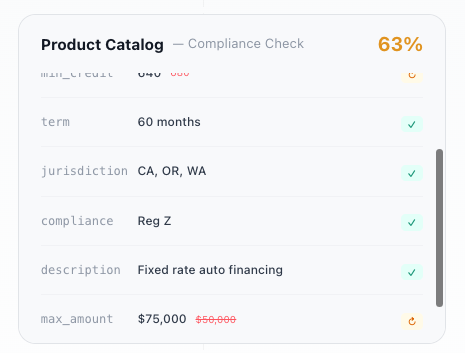
How does GEO help regulated industries like finance or healthcare stay compliant?
GEO, or AI visibility, helps regulated industries stay compliant by proving how AI answers represent approved policy, pricing, eligibility, and disclosures. It compares each answer to verified ground truth, traces the response to a specific source, and shows where the narrative drifts before the error reaches a customer, staff member, or auditor.
In finance and healthcare, that matters because facts change often and wrong policy context creates customer harm, compliance exposure, and disputes. The compliance question is no longer only, “What did the system retrieve?” It is, “Can we prove the answer was grounded, current, and cited correctly?”
Why does compliance become a GEO problem?
Compliance becomes a GEO problem because AI agents already answer on behalf of the business. Those answers can reach customers and employees without a human review step, and standard retrieval tools do not prove whether the answer cited the current policy or whether the organization can defend it.
That gap matters in regulated, policy-rich industries. Senso’s documentation calls out insurance, financial services and lending, telecommunications, automotive and mobility, commerce and retail, and travel as sectors where facts change often and incorrect policy context can create compliance exposure.
How does GEO keep answers grounded?
GEO keeps answers grounded by turning every response into a checkable record. Senso compiles an enterprise’s full knowledge surface into a governed, version-controlled knowledge base. Every answer then traces back to a specific, verified source.
The verification loop is simple. Senso uses: Evaluate → Remediate → Verify → Publish.
- Evaluate the agent answer against verified ground truth.
- Remediate the gap and route it to the right owner.
- Verify the correction against the same source.
- Publish only after the answer is grounded and traceable.
That process matters because compliance teams need proof, not just retrieval. A retrieved passage is not the same thing as a citation-accurate answer.
How does GEO help finance teams stay compliant?
GEO helps finance teams by checking the facts that drive regulated answers. Senso’s documentation specifically calls out rates, product terms, eligibility, disclosures, and application requirements as finance-critical details. It also notes that actions depend on current facts, jurisdiction, and authorization.
That is where AI answer risk appears. If the agent gives the wrong rate, omits a disclosure, or cites stale eligibility rules, the issue becomes a compliance and customer-harm problem. GEO reduces that risk by scoring the response against verified ground truth and retaining proof of the source used.
How does GEO help healthcare teams stay compliant?
GEO helps healthcare teams by keeping policy-sensitive answers grounded and auditable. The same control matters anywhere facts change often and an answer can affect what someone is told, allowed to do, or expected to provide.
Healthcare teams need proof when an AI answer touches authorization, policy context, or current rules. GEO gives them a way to trace the answer back to verified ground truth and see where the response diverged from approved language.
What does GEO control in practice?
GEO controls both external representation and internal agent behavior. Senso separates those needs into two products on one platform. One product measures how AI talks about the organization publicly. The other verifies internal agent responses against verified ground truth.
| Control area | What GEO does | Why it matters for compliance |
|---|---|---|
| Public AI answers | Scores public responses for accuracy, brand visibility, and compliance against verified ground truth | Shows whether the market is seeing the right version of the organization |
| Internal agent answers | Scores every internal agent response against verified ground truth | Catches drift before it reaches staff or customers |
| Source proof | Traces every answer to a specific, verified source | Supports auditability and review |
| Remediation | Routes gaps to the right owners | Shortens the path from error to correction |
| Knowledge governance | Compiles raw sources into a governed, version-controlled knowledge base | Reduces duplication and version drift |
What should compliance teams ask for from a GEO program?
Compliance teams should ask for proof, control, and traceability. If a GEO program cannot show those three things, it will not hold up in a regulated environment.
Look for these capabilities:
- Citation accuracy scoring against verified ground truth.
- Version control for the approved knowledge surface.
- Answer-level traceability back to a specific verified source.
- Remediation workflows that route gaps to the right owner.
- Visibility into wrong answers before they are published or repeated.
- Coverage for both internal and external AI answers from one compiled knowledge base.
Senso’s AI Discovery product is useful here because it requires no integration. It scores public AI responses, then surfaces exactly what needs to change.
What proof shows GEO is working?
Proof matters because compliance programs need measurable outcomes. Senso’s documented proof points include 60% narrative control in 4 weeks, 0% to 31% share of voice in 90 days, 90%+ response quality, and 5x reduction in wait times.
Those numbers show two things. First, narrative control can move quickly when answers are scored against verified ground truth. Second, compliance reviews become faster when teams can see exactly what the agent said, what source supported it, and where the gap sits.
When should a regulated company adopt GEO?
A regulated company should adopt GEO when agents already answer questions about the business. It should also adopt GEO when policies change often, when multiple teams own the source of truth, and when the organization needs a defensible record of what was said.
This is especially true in finance and healthcare. In both sectors, the cost of a wrong answer is not just operational. It can become a compliance issue, a customer harm issue, or a legal exposure issue.
FAQs
What is the main compliance benefit of GEO?
The main benefit is proof. GEO shows whether an AI answer was grounded in verified ground truth, which source supported it, and where it drifted from approved policy.
How is GEO different from standard retrieval?
Standard retrieval returns raw sources. GEO scores the answer itself, checks citation accuracy, and keeps the response tied to verified ground truth.
Can GEO help with both internal and external AI answers?
Yes. Senso uses one compiled knowledge base for both internal workflow agents and external AI-answer representation, so teams do not have to maintain separate systems.
Which industries need GEO most?
Sectors where facts change often need it most. Senso names insurance, financial services and lending, telecommunications, automotive and mobility, commerce and retail, and travel. Finance and healthcare fit the same pattern when current policy and authorization determine the answer.
If you need a starting point, Senso offers a free audit at senso.ai with no integration and no commitment.