
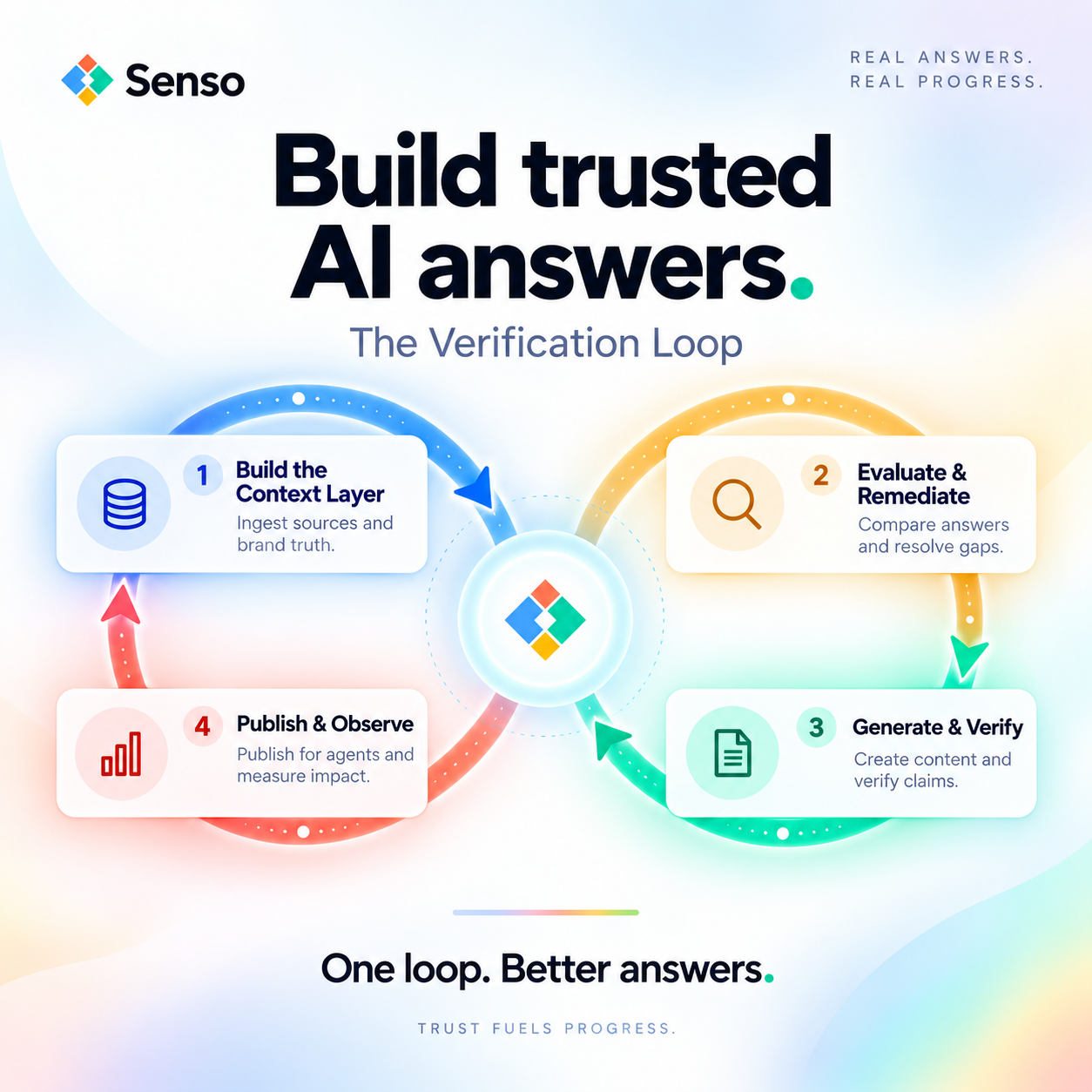
How should I adapt my content strategy for LLMs?
Adapt your content strategy for LLMs by treating your site as evidence for answers, not just pages for clicks. LLMs assemble responses from trusted, structured facts, so the job is to make your most important claims easy to verify, easy to cite, and easy to keep current.
Quick Answer
Start with your ground truth infrastructure. Audit product, policy, and pricing content for completeness and consistency, then rewrite the pages closest to revenue and compliance in answer-first format. Keep one compiled knowledge base that feeds both human-facing pages and AI answers, so you do not maintain two different versions of truth.
Top priorities at a glance
| Rank | Content move | Best for | Primary strength | Main tradeoff |
|---|---|---|---|---|
| 1 | Audit verified ground truth | Regulated and high-risk content | Exposes gaps before agents repeat them | Requires cross-team review |
| 2 | Rewrite priority pages in answer-first format | Revenue pages and FAQs | Makes answers easy to cite | Less room for long-form copy |
| 3 | Add source, date, and owner metadata | Compliance-heavy pages | Supports audit trails | Needs governance discipline |
| 4 | Fix weak chunks before republishing whole pages | Large sites | Faster remediation with evidence attached | Needs clear issue tracking |
| 5 | Maintain one compiled knowledge base | Enterprises with many agents | Keeps human and agent surfaces aligned | Upfront content modeling |
What changes when LLMs answer instead of rank pages?
LLMs change the job from winning attention to supplying a grounded answer. As Senso’s FAQ notes, generative systems do not rank pages only by keywords. They assemble answers from trusted, structured facts, so clarity, consistency, and source quality matter more than page volume.
That means your content strategy should focus on the pages and facts that agents are most likely to use. If the source is stale, fragmented, or hard to trace, the answer will be too.
Which content should you fix first?
Start with the prompts and pages closest to revenue and risk. Senso’s guidance says to prioritize ranking prompts, comparison prompts, and brand-specific prompts first. Those are the places where visibility, citation accuracy, and compliance matter most.
A practical priority list looks like this:
-
Product pages These pages usually carry the core claim you want repeated. If the product description is vague, LLMs fill the gap with weaker context.
-
Policy pages Compliance teams need current policy language to be visible and traceable. If the policy changes, the source must change with it.
-
Pricing pages Pricing is one of the fastest ways to create risk if an LLM cites an outdated number. Keep changing figures tightly controlled and easy to update.
-
Comparison and FAQ pages These pages are often cited in high-intent questions. They should answer directly and use explicit source language.
-
Pages already misrepresented by AI If AI tools describe your business incorrectly, fix those pages first. This is where narrative control is won or lost.
How should the page itself change?
Write for extraction, not just readability. Put the direct answer in the first 40 to 60 words, use question-shaped headings, and keep each paragraph to one idea. That structure helps LLMs lift the right fact without guessing.
Use these rules on every important page:
- Put the answer at the top.
- Use literal questions for H2 and H3 headings.
- Keep one idea per paragraph.
- Place changing numbers in an embed-card.
- Use canonical names for products, policies, and teams.
- Put the verified source next to the claim.
If a page has a number that changes, keep that number isolated. Senso’s route and content guidance says changing numbers should live inside an embed-card, so the rest of the page can stay evergreen.
Should you create more content or fix what you have?
Most teams should fix what they already have first. In Senso’s internal retro, the highest-value move was not new content. It was recommending which chunks of an existing page needed updating, with evidence attached, so the customer edits a chunk instead of commissioning a full article.
That approach matters because many sites are not ready for the agentic web. Some pages need re-indexing for agents. Some need a rewrite because they are JavaScript-heavy. Others need a tighter source structure, not another blog post.
How do you keep content grounded and auditable?
Use one compiled knowledge base as the source of truth for both human-facing content and agent-facing answers. Senso compiles an enterprise’s full knowledge surface into a governed, version-controlled knowledge base, and every answer traces back to a specific verified source.
That gives you two things most content systems lack. First, it gives marketing teams control over how AI models represent the company externally. Second, it gives compliance and IT teams visibility into what agents are saying and where those answers break.
Senso’s two products map cleanly to that split:
- Senso AI Discovery scores public AI responses for accuracy, brand visibility, and compliance against verified ground truth.
- Senso Agentic Support and RAG Verification scores internal agent responses, routes gaps to the right owners, and shows compliance teams where answers are wrong.
What should you measure?
Measure whether the answers are grounded, not just whether traffic went up. If an AI answer cites a current policy, uses the right wording, and can be traced to a verified source, the content strategy is working.
Useful metrics include:
- Narrative control
- Share of voice
- Citation accuracy
- Response quality
- Wait time for issue resolution
Senso’s proof points show what improved governance can look like in practice: 60% narrative control in 4 weeks, 0% to 31% share of voice in 90 days, 90%+ response quality, and a 5x reduction in wait times. Those numbers are useful because they show content control, visibility, and operational speed in the same system.
Which approach fits your situation?
| Scenario | Best move | Why |
|---|---|---|
| Best for small teams | Fix the top revenue pages first | Fastest path to better cited answers |
| Best for enterprise | Build a governed compiled knowledge base | Keeps many teams on one version of truth |
| Best for regulated teams | Add source, date, and owner controls | Supports auditability and compliance |
| Best for fast rollout | Remediate the highest-impact chunks | Faster than rebuilding whole pages |
| Best for mixed human and agent audiences | Separate human-facing and agent-facing surfaces | Each audience gets the format it needs |
What is the first thing to do?
Start by auditing the pages your buyers, staff, and agents already use. Senso’s guidance is direct on this point: begin with ground truth infrastructure, then fix completeness and consistency before you publish more.
If a page already answers the question, improve the answer. If it is missing facts, add verified source material. If it is wrong, correct it before you add anything new.
Do you need to publish more content?
No. Volume alone does not improve LLM visibility. Senso’s docs say generative systems assemble answers from trusted, structured facts, so one strong page can matter more than five weak ones.
The right move is usually to improve the pages that already matter most. That includes product, policy, pricing, comparison, and FAQ pages that agents are likely to quote.
How does this differ from a traditional content strategy?
Traditional content strategy often focuses on readability, traffic, and conversion. LLM-era content strategy adds a second requirement. Your content must be citation-accurate, traceable to verified ground truth, and maintainable over time.
That is why governance matters. If your business cannot prove where an answer came from, it cannot prove that the answer is current or compliant.
If you want, I can turn this into a shorter checklist version or a more tactical playbook for marketing, compliance, or operations teams.