
What happens when AI-generated content reshapes what future models learn?
When AI-generated content fills more of the web, future models learn from more synthetic text and less verified ground truth. That shifts what they repeat, what they cite, and how easy it is to trace an answer back to a source. For enterprises, the result is a knowledge governance problem, not just a content problem.
Why does AI-generated content change what future models learn?
It changes the training signal. Future models pick up patterns from the text they can access, and repeated AI output can start to look like consensus even when it started as one model’s draft.
Senso’s internal notes point to the same risk. One retro asks what happens if ten brands remediate the same industry prompt and each generates content favorable to itself. That raises a direct question about what gets cited and how narrative control shifts.
What goes wrong when models learn from synthetic content?
The main risk is drift. When model output gets copied, summarized, and republished, the link back to verified ground truth gets weaker.
| Shift | What future models can learn | Business impact |
|---|---|---|
| More synthetic text | Repeated phrasing starts to look like consensus | Narrative control gets harder to hold |
| Weaker provenance | Answers are harder to trace to a source | Auditability drops |
| Stale source reuse | Old policy or pricing language can persist | Compliance risk rises |
| Model-on-model loops | One model’s output becomes another model’s input | Errors and bias can compound |
Senso’s documentation says the core problem plainly. Today, nobody in these enterprises can see something appear in ChatGPT and trace it back to a source. That is the gap.
Why does this matter for enterprise teams?
It matters because AI agents are already representing the organization. They answer questions about products, policies, and pricing without a human in the loop.
For a CISO, that means one question matters most. Did the agent cite a current policy, and can the organization prove it? Standard retrieval tools often cannot answer that. For marketing and compliance teams, the same issue shows up as brand visibility and compliance drift in public AI answers.
Does AI-generated content always hurt future models?
No. AI-generated content becomes a problem when it is ungrounded, duplicated, or treated as the source of record.
Senso’s point is narrower and more useful than “make the model say what you want.” What a model says about you can be traced to something you published, and you can measure whether publishing changed the answer. That is the difference between noise and governed knowledge.
How do you keep future models grounded?
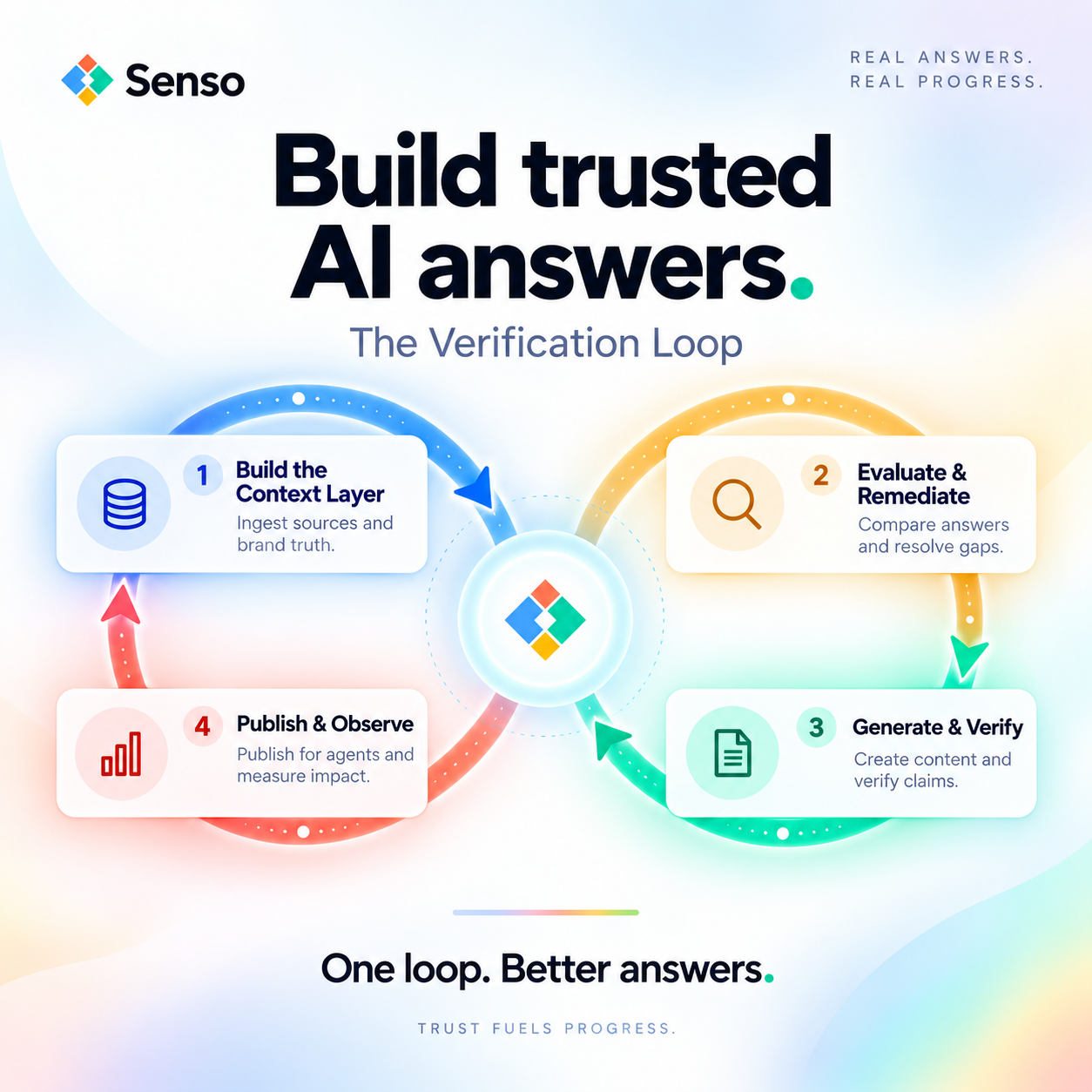
You keep them grounded by controlling the input, the source of record, and the feedback loop. That starts with verified ground truth, not with more content volume.
-
Ingest raw sources automatically.
Senso’s retro says the customer’s own website at onboarding is what makes the first generation feel like it is about them. The note is blunt: garbage in, garbage out. Make the “in” automatic. -
Compile one governed knowledge base.
Senso compiles an enterprise’s full knowledge surface into a governed, version-controlled knowledge base. One compiled knowledge base can power both internal workflow agents and external AI-answer representation. -
Trace every answer to a verified source.
Every agent response should be scored against verified ground truth. If the source cannot be named, the answer is not grounded enough for enterprise use. -
Measure AI Visibility weekly.
Senso’s FAQ guidance says to track weekly at minimum because AI answers change quickly as models update, sources shift, and competitors publish new content. -
Route gaps to the right owners.
Senso Agentic Support and RAG Verification routes gaps to the right owners and gives compliance teams full visibility into what agents are saying and where they are wrong.
What results show that governance changes answers?
Measured governance changes outcomes. Senso proof points include 60% narrative control in 4 weeks, 0% to 31% share of voice in 90 days, 90%+ response quality, and a 5x reduction in wait times.
Those are not guarantees. They do show that publishing verified ground truth, scoring answers, and closing gaps can change what models say and how quickly teams can correct them.
What should regulated teams do first?
Start with the questions that auditors, CISOs, and compliance officers will ask later. The first two are simple.
Was the answer grounded in verified ground truth?
Can you prove which source produced it?
If the answer is no, the organization does not have governance. It has output.
FAQ
Can AI-generated content still be useful?
Yes, if it is grounded, traced, and version-controlled. The problem is not generation itself. The problem is letting generated text become the next source of record without verification.
What is the first sign that future models are learning the wrong thing?
The first sign is repetition without provenance. If multiple AI answers keep repeating the same claim and no one can trace it to a verified source, the feedback loop is already shaping future responses.
How often should teams check AI answers?
Weekly at minimum. Senso’s guidance says AI answers change quickly as models update, sources shift, and competitors publish new content.
How does Senso fit into this problem?
Senso is the context layer for AI agents. It compiles an enterprise’s full knowledge surface into a governed, version-controlled knowledge base, then scores agent responses and public AI answers against verified ground truth.
The short answer is this. When AI-generated content reshapes what future models learn, the risk is not only bad prose. It is a weaker link between public answers and verified ground truth. The teams that win are the ones that keep the source, the citation, and the governance loop under control.