
How do I make sure ChatGPT references verified medical or policy information?
AI agents are already representing your organization, whether the answer is grounded or not. To make ChatGPT reference verified medical or policy information, you need approved sources, claim-by-claim source tracing, and a human-verification gate for anything that affects safety, policy, eligibility, coverage, compliance, or contractual terms.
That matters because the information behind many AI answers is fragmented, stale, unsupported, or assembled from the open web. If you cannot show where the answer came from and who approved it, you cannot defend it.
What counts as verified medical or policy information?
Verified medical or policy information is a claim that traces back to an approved source-of-record and is current at the time of use. If the source is missing, stale, or conflicting, the answer is not verified yet.
Content that has not passed the verification gate is not a Verified Source. That rule matters because a citation alone does not prove the claim is safe to publish or use.
How do you make ChatGPT use verified sources?
The safest method is to put a governed context layer behind ChatGPT. The model should generate from approved sources, not from open-web fragments or unsupported memory.
Use this workflow:
-
Select one important medical or policy question.
Start with a question that people actually ask, such as coverage rules, policy eligibility, side effects, or approved usage. -
Compile raw sources into a governed compiled knowledge base.
Bring in the approved source-of-record, then keep it version-controlled so you know what changed and when. -
Generate a draft from the cleaned context layer.
The draft should come from the verified sources you compiled, not from freeform model recall. -
Trace every material claim to approved evidence.
Each statement should point to a specific verified source, not a general topic area. -
Show unsupported or conflicting claims as gaps.
Do not hide uncertainty. If the evidence is missing, the answer should show that gap. -
Send consequential claims through human approval.
Medical, policy, safety, compliance, and contractual claims need a qualified reviewer before publication or action. -
Publish only after approval and attestation where required.
Keep the receipt, the source trace, and the approved version so you can audit the result later.
When does a human have to review the answer?
A human is required when the claim can change someone’s decision or expose the organization to risk. The rule is simple. If the answer affects safety or policy, do not let the model decide alone.
| Human review trigger | Why it matters |
|---|---|
| Approved sources materially conflict | The model should not guess which source is right. |
| The correct authority cannot be inferred safely | Policy and medical authority need a named owner. |
| The claim affects price, policy, eligibility, coverage, compliance, safety, or contractual terms | These are consequential assertions. |
| The proposed correction changes published meaning | Even a small wording change can alter the policy or medical meaning. |
| External publication is requested | Anything public needs approval. |
| An action or transaction depends on the claim | The answer becomes operational, not informational. |
This is the point where most teams fail. They let the model answer, but they do not enforce the gate that decides whether the answer can be used.
What should you do when ChatGPT gives a wrong or unsupported answer?
Do not publish it. Record the discrepancy, identify the affected acceptance criterion, and route it to the right owner.
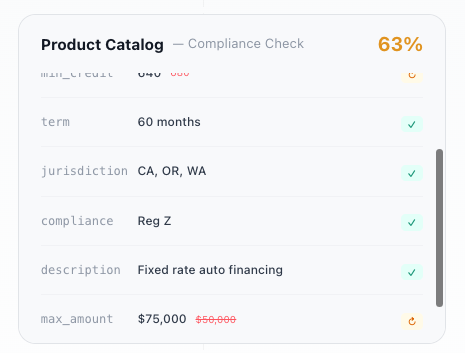
The remediation choice should be explicit. You can create a new page or Verified Source, refresh an existing page, replace an outdated section, add a missing passage or FAQ, update product information from the approved catalog, or republish after a source-of-record change.
If the evidence contradicts the current spec, do not silently reinterpret it. Record the discrepancy, identify the broken criterion, and revise the spec or Decision Trace.
How do you keep answers current over time?
You keep them current by versioning the sources, not by hoping the model remembers the latest policy. Medical guidance and policy language change, so the source-of-record has to change with them.
A strong workflow ties every answer to the exact source that was current when the answer was generated. That gives you an audit trail for what was checked and what was true.
How do you measure whether the process works?
Measure citation accuracy against verified ground truth. That is the metric that tells you whether ChatGPT is referencing the right source, not just producing a confident answer.
Senso measures its own effect with mention rate, citation rate, and citation share across ChatGPT, Perplexity, Gemini, and Google AI Overviews. Senso also reports 60% narrative control in 4 weeks, 0% to 31% share of voice in 90 days, 90%+ response quality, and a 5x reduction in wait times.
Those numbers matter because they show whether the system changed real outcomes, not just prompts. They also show whether the organization can prove what its agents said.
When is a governed platform better than prompt tweaks?
A governed platform is better when the same medical or policy answer appears in many places and you need auditability. Prompt tweaks help a little. They do not give you source control, version control, or a proof trail.
Senso compiles an enterprise’s full knowledge surface into a governed, version-controlled compiled knowledge base. Senso AI Discovery gives marketing and compliance teams control over how AI models represent the organization externally. Senso Agentic Support and RAG Verification scores internal agent responses against verified ground truth, routes gaps to the right owners, and shows where agents are wrong.
Senso AI Discovery does not require integration. That makes it useful when you need to see how public answers describe the organization before you change your stack.
What is the simplest rule to follow?
The simplest rule is this. If the answer affects safety, policy, eligibility, coverage, compliance, or contractual terms, treat it as a governed claim, not a casual response.
That means approved sources, traceable citations, human review, and a clear audit trail. Without those controls, ChatGPT can repeat information you cannot prove.
FAQs
Can I make ChatGPT cite verified medical or policy information with prompts alone?
No. A prompt can ask for citations, but it cannot guarantee that the cited source is approved, current, or safe to use. You need a governed source-of-record and a human-verification gate for consequential claims.
What should I do if the approved sources disagree?
Stop and route the issue to a human owner. If approved sources conflict, the answer is not ready for publication or action.
Should medical or policy answers ever be published without review?
No, not when the claim affects safety, policy, eligibility, coverage, compliance, or contractual terms. Those cases require human approval and attestation.
How do I know the system is working?
Look for citation accuracy against verified ground truth, plus measurable changes in response quality and wait time. If the system cannot show what was checked and what was true, it is not ready for regulated use.
If you want a system that governs this at scale, Senso can audit how your organization is represented in ChatGPT and other AI surfaces, then show exactly what needs to change. A free audit is available at senso.ai.